Travel & Tourism Development Index 2026


2. Global context
Global travel demand has remained remarkably resilient despite higher costs and a more volatile geopolitical and economic environment.
Figure 2: Global tourism reaches new highs
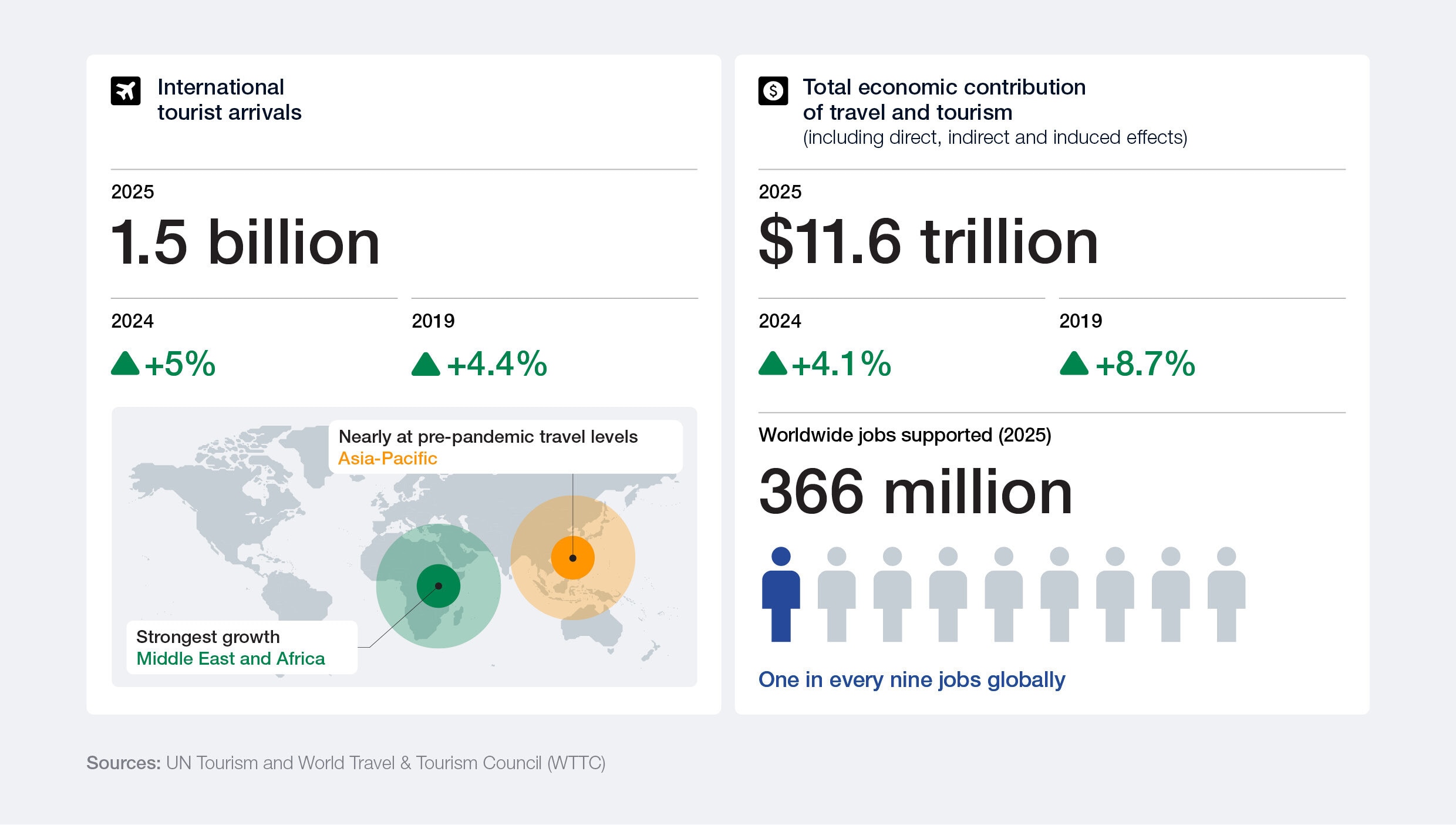

International tourist arrivals reached a record 1.5 billion in 2025, up 5% on 2024 and 4.4% above 2019 levels. Growth was strongest in the Middle East and Africa, while Asia-Pacific continued to close the gap with pre-pandemic travel levels.4
The total economic contribution of travel and tourism (T&T), including direct, indirect and induced effects, reached a record $11.6 trillion in 2025, up 4.1% on 2024 and 8.7% compared with 2019. This was equivalent to nearly 10% of global GDP. This output has supported 366 million jobs worldwide, representing around one in every nine jobs globally.5
Sector economic growth was supported by growing leisure and business travel spending. Accounting for more than 80% of traveller spending, leisure spending increased by 3.5% to $6.1 trillion in 2025. Supported by the return of in‑person meetings, conferences and events, business travel spending climbed 4%, reaching $1.5 trillion worldwide over this period.6
Domestic travel remained the largest source of demand in 2025, accounting for 73.6% of total traveller spending and valued at $5.6 trillion, up 3.7% on 2024. This was slightly faster than growth in international visitor spending, which increased by 3.2% to $2 trillion.7 In many economies, this domestic base has helped sustain tourism businesses and infrastructure, providing a buffer against volatility in international demand.
The resilience of international arrivals and traveller spending during 2025 is notable given inflation in tourism services and a backdrop of economic and geopolitical uncertainty.8
These pressures intensified from late February 2026, when the conflict in the Middle East escalated, affecting global travel networks. Airspace closures, security concerns and restrictions across parts of the Middle East disrupted a critical aviation corridor linking Europe, Asia, Australia and Africa, with knock‑on effects on flight times, fuel costs, airfares, schedules and traveller confidence. In April 2026, traffic (revenue passenger kilometres) carried by Middle Eastern carriers contracted by 46.6% year on year, dragging global air traffic down by 3.4% – the first contraction since the post-pandemic recovery.9
The Middle East conflict illustrates how quickly geopolitical disruptions can affect T&T through interconnected transport networks. Localized shocks can have wider operational and commercial consequences, particularly when they affect major aviation corridors. Climate-related disruptions have also become increasingly visible. During the summer of 2026, severe heatwaves and wildfires affected parts of southern Europe, including Spain and France.10 Despite these disruptions, travel demand continued to recover. International tourist arrivals increased by 2% in the first quarter of 2026, with growth in every region except the Middle East. This underlines the sector’s underlying resilience.11