

About the Travel & Tourism Development Index 2026
The TTDI 2026 helps governments, businesses and destination leaders understand what drives tourism success, identify opportunities for improvement and benchmark performance against peers.
The Travel & Tourism Development Index (TTDI) builds on nearly two decades of the World Economic Forum’s work on travel and tourism (T&T) benchmarking. It has evolved from the Travel & Tourism Competitiveness Index (TTCI), published biennially from 2007 to 2019. Relaunched in 2022 in its current form, it reflects a broader focus on sustainable and resilient development, beyond competitiveness alone.
The TTDI measures the factors and policies that enable the sustainable and resilient development of the T&T sector, which in turn contributes to economic and social development. It does not measure tourism performance – such as arrivals, spending or revenue – directly, but the conditions that determine how well a destination can attract, support and sustain T&T in ways that generate benefits for economies and societies. By enabling cross-country comparison and tracking these conditions across successive editions, the index informs policy, investment and operational decisions, identifies strengths and gaps, and supports dialogue among governments, industry, communities and international partners.
The 2026 edition was produced in collaboration with Zurich Insurance Group, drawing on Zurich’s role as one of the world’s largest travel insurers and a leading provider of protection and resilience advice to the sector.
The index is also informed by the Beyond Tourism Insights Council, whose members include American Express Global Business Travel, the Asian Development Bank, Bloom Consulting, Cinnamon Hotels, Destinations International, the European Travel Commission, the Global Sustainable Tourism Council, Hong Kong Polytechnic University, the International Air Transport Association, the Inter- American Development Bank Group, the JLL Global Tourism and Destination Development Group, Kearney, Microsoft, MMGY TCI Research, New York University, the Pacific Asia Travel Association, Sommet Education, Technogym, Trip.com Group, UN Tourism, the University of Surrey, Visa, the World Bank Group, the World Travel & Tourism Council and Zurich Cover-More.
Additional information on methodology, country and income group classifications, indicator definitions and interactive data visualizations is available on the index website and in the Technical notes and methodology section of this report.
1.1 Index overview
The TTDI framework is organized around five dimensions, 17 pillars and 102 individual indicators. The five dimensions provide a high‑level structure for organizing and presenting the index but are not used in calculating the overall scores.
Figure 1: TTDI framework
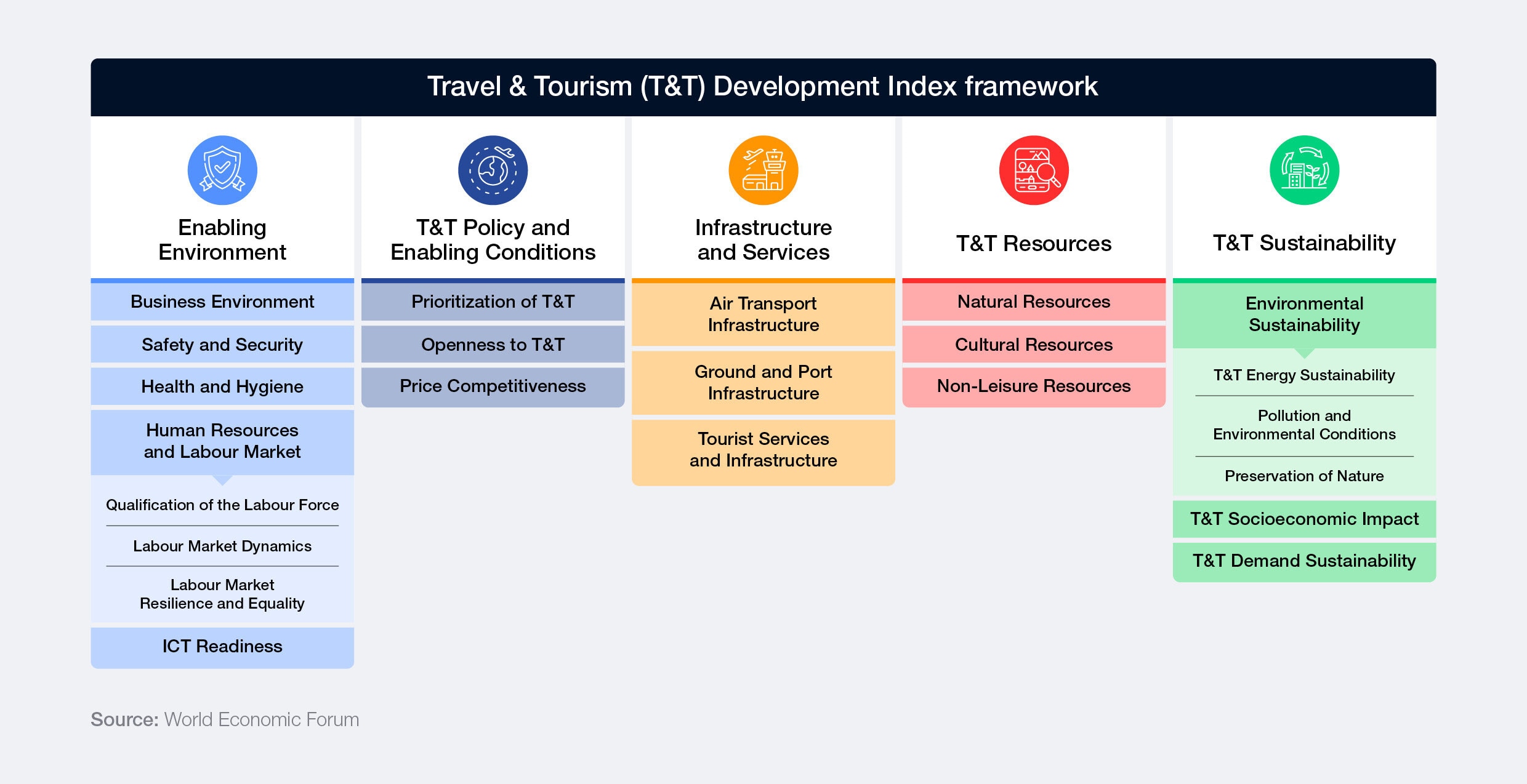

The Enabling Environment dimension captures the general conditions necessary for operating and investing in a country and consists of five pillars:
- Business Environment: This pillar captures the extent to which a country’s policy environment is conducive to companies doing business and investing.
- Safety and Security: This pillar measures the extent to which a country exposes locals, tourists and businesses to security risks.
- Health and Hygiene: This pillar measures healthcare infrastructure and accessibility and health security.
- Human Resources and Labour Market: This pillar measures the availability of quality employees and the dynamism, resilience and equality of the labour market, as well as the level of protection for workers. It consists of three subpillars: Qualification of the Labour Force,Labour Market Dynamics and Labour Market Resilience and Equality.
- ICT Readiness: This pillar measures the availability and use of information and communication technology (ICT) infrastructure and digital services.
The T&T Policy and Enabling Conditions dimension captures specific policies or strategic aspects that affect the T&T sector more directly and consists of three pillars:
- Prioritization of T&T: This pillar measures the extent to which the government actively promotes, tracks and invests in the development of the T&T sector.
- Openness to T&T: This pillar measures how open a country is to visitors and facilitating cross-border travel.
- Price Competitiveness: This pillar measures how costly it is to visit, travel within and operate in a country.
The Infrastructure and Services dimension captures the availability and quality of physical infrastructure and tourism services and consists of three pillars:
- Air Transport Infrastructure: This pillar measures the extent to which a country’s infrastructure offers sufficient air connectivity and access for travellers domestically and internationally.
- Ground and Port Infrastructure: This pillar measures the availability of efficient and accessible ground and port transportation services and infrastructure.
- Tourist Services and Infrastructure: This pillar measures investment in, and the availability and productivity of, tourist services and infrastructure.
The T&T Resources dimension captures the principal “reasons to travel” to a destination and consists of three pillars:
- Natural Resources: This pillar measures the available natural capital as well as the development of outdoor tourism activities. Natural capital is defined in terms of landscape, natural parks and the richness of the fauna. To an extent, this pillar captures how natural resources are promoted rather than the actual existing natural heritage of a country.
- Cultural Resources: This pillar measures the availability of cultural resources such as archaeological sites and entertainment facilities. To an extent, this pillar captures how cultural resources are promoted and developed rather than the actual existing cultural heritage of a country.
- Non-Leisure Resources: This pillar measures the extent and attractiveness of factors that drive business and other non-leisure travel, including the presence of global cities, major corporations and leading universities.
The T&T Sustainability dimension captures the current or potential sustainability challenges and risks facing T&T and consists of three pillars:
- Environmental Sustainability: This pillar measures the T&T sector’s energy sustainability and the general sustainability of an economy’s natural environment and the protection of natural resources. It consists of three subpillars: T&T Energy Sustainability, Pollution and Environmental Conditions, and Preservation of Nature.
- T&T Socioeconomic Impact: This pillar measures the economic and social impact of T&T, including induced economic contribution, the provision of high-wage jobs and workforce gender equality.
- T&T Demand Sustainability: This pillar measures factors that may indicate the existence of, or risks related to, excess demand for tourism or inadequate demand, demand volatility and other potentially unsustainable demand trends.
Pillar definitions and the full list of indicators are set out in the Technical notes and methodology section of this report.
1.2 Data and methodology
Most TTDI indicators are quantitative measures sourced from international organizations, public datasets and private-sector data providers. The remainder come from the World Economic Forum’s annual Executive Opinion Survey, used where comparable statistical data is limited.
Data sources include AirDNA, Arton Capital, Bloom Consulting, the CIA World Factbook, CoStar, Euromonitor International, GlobalPetrolPrices. com, the International Air Transport Association, the International Civil Aviation Organization, the International Labour Organization, the International Telecommunication Union, the International Union for Conservation of Nature, MMGY TCI Research, Tripadvisor, the United Nations Educational, Scientific and Cultural Organization (UNESCO), the UN Statistics Division, UN Tourism, the World Bank, the World Database on Protected Areas, the World Health Organization, the World Trade Organization and the World Travel & Tourism Council.
Overall TTDI scores are calculated through successive aggregations, beginning at the indicator level and progressing through pillars using a simple arithmetic mean. Indicator values are normalized to a common scale of 1 (worst outcome) to 7 (best outcome), ensuring consistency across data sources. Where data is missing, established imputation methods are used; full details are set out in the Technical Notes and Methodology section of this report.
Data revisions, changes in economy coverage, and minor indicator adjustments limit comparability with previous editions of the TTDI. The 2026 edition includes recalculated figures for 2019, 2021 and 2024, using new adjustments, reflecting the latest available data at the time of collection (May 2026).
1.3 Economy coverage
The TTDI covers 110 economies. Economies included in 2024 but not covered in the 2026 edition are Barbados, Cambodia, Iran, Lebanon, Moldova, Montenegro, Tajikistan, Trinidad and Tobago, and Venezuela. No new economies were added in the 2026 edition. Criteria for economy inclusion and exclusion are set out in the Technical notes and methodology section of this report.
1.4 How to read this report
To properly interpret the TTDI findings please keep the following in mind:
- The index measures the factors and policies that enable sustainable and resilient development of the T&T sector. It does not measure tourism performance – such as arrivals, spending or revenue – directly.
- As noted above, data revisions, changes in economy coverage and minor indicator adjustments significantly reduce comparability with previously published TTDI editions. Users should compare historical results only using the recalculated figures published with this edition of the index.
- Unless otherwise stated, references to regional, pillar and overall TTDI scores reflect the mean value for that grouping.
- The TTDI results reflect the latest available data at the time of collection (May 2026). For some indicators, the latest available figures may be several years old and vary between economies. As a result, more recent policy changes and economic, social or environmental developments may not always be reflected in the results.
- While global rankings provide a useful basis for comparing economies, they should be interpreted alongside the regional context, strategic priorities and national circumstances. Two economies may have similar scores and rankings but differ significantly in areas such as the business environment, price competitiveness, infrastructure, natural and cultural resources, and sustainability. The importance of these factors will vary depending on regional competitors and national goals for T&T.