ポッドキャスト・トランスクリプト
Linda Lacina, Meet The Leader: Welcome to Meet the Leader, the podcast where top leaders share how they're tackling the world's toughest challenges. In today's episode, the latest in our Chief People Officer series, we talk about navigating upskilling's messy middle and what is needed to fix the skills mismatch. Subscribe to Meet The Leader on Apple, Spotify, and wherever you get your favourite podcasts so you don't miss an episode. And don't forget to rate and review us. I'm Linda Lacina from the World Economic Forum, and this is Meet the Leader.
Maria Flynn, CEO, Jobs for the Future: The worst-case scenario that we want to avoid is having workers who do not have the skills that are needed for the jobs of today and for the future.
Linda Lacina, Meet The Leader: What is one of the biggest problems facing the labour market today? If you were gonna say a talent shortage, you would be wrong. According to our recent Chief People Officer Outlook, one of the biggest constraints is the skill mismatch.
Organizations are struggling matching talent to roles, not struggling with supply itself, which means many companies we surveyed are leaning on skills-based hiring. Maria Flynn understands this. She is the CEO of Jobs for the Future. Jobs for the Future is a non-profit in the U.S that's working to reform workforce and education systems to ensure that every worker and every learner can advance economically.
Our education and workforce systems were really built for a different era and they are not equipped to be keeping pace with the changes that we are seeing in the labour market driven by artificial intelligence and advancements in technology.
”It also has one great big goal, 75 million quality jobs by 2033. That's doubling the number of quality jobs that workers are in today. That will take tackling the skills mismatch. She'll talk to us more about that mismatch and also what needs to be in place for a quality job. And what's working right now when it comes to AI adoption? Stay to the end for my little special game of 'Red Light, Green Light.' That's a game where she tells me which hot new work trend will actually go forward. But for now, she will start us off on a hot take, the trend that no one is talking enough about: The system.
Maria Flynn, CEO, Jobs for the Future: Our education and workforce systems were really built for a different era and they are not equipped to be keeping pace with the changes that we are seeing in the labour market driven by artificial intelligence and advancements in technology overall. So, we are really kind of building for a future on a system that was built for the past and we need to solve that problem.
Linda Lacina, Meet The Leader Why is this so important to fix? What's the worst-case scenario we want to avoid?
Maria Flynn, CEO, Jobs for the Future: So the worst-case scenario that we want to avoid is having workers who do not have the skills that are needed for the jobs of today and for the future. And the issue is that our education systems, our public workforce systems, often are not agile enough to make the changes that are needed to really keep pace with what employers are asking for. So really, we run the risk of divorcing supply and demand because the systems aren't agile enough to keep pace and to kind of be moving forward together. And really, the solves for this are a combination of policy change, practice changes and also mindset changes. So how can we really be building and investing in future-forward systems in this moment of rapid change?
Linda Lacina, Meet The Leader: And, what does the world look like, maybe in ten years, if we're able to get some of that in place?
Maria Flynn, CEO, Jobs for the Future: Ten years from now, if we are able to have our systems in an agile fashion, really with the investments that we need, we will be seeing workers have the ability to access quality jobs more readily, we will see them being able to enhance their skills kind of throughout their lifetime in a true lifelong learning model, not like a traditional one-and-done approach where you go to school and then you go to work.
I think we'll have a much more seamless system of learning and earning that can kind of ebb and flow throughout a person's lifetime and throughout their career.
Linda Lacina, Meet The Leader: What is a quality job?
Maria Flynn, CEO, Jobs for the Future: So, a quality job we believe has five essential elements, and we established the American Job Quality Study last year as a way of really having a common way for everyone to talk about job quality and to really think about the five dimensions of a job quality. And really briefly, the first is, probably what you would think of first, is pay and benefits, but beyond that, the second is really looking at the ability for a worker to advance in their career. The third is ensuring workers have agency in their work, so have the ability to have a voice in decisions within the workplace, that they have a safe and respectful workforce, that they have a safe experience at work and then, finally, that they have access and some control over their schedule.
We realized that for every individual, the right mix of those dimensions may vary and the mix of dimensions might vary across their career. There might be times where schedule is more important to you and there might be time where salary is more important, but these dimensions really let us take a kind of 3D approach of looking at job quality across sectors and across levels of occupations.
Many workers, over 60%, are saying that they wish they had more say in how technology, including artificial intelligence, is being deployed within their company.
”Linda Lacina, Meet The Leader: And, sort of in practice, what have you guys been seeing that works to sort of make those things possible, put that in place? Can you give us a couple of examples of what you guys are making happen?
Maria Flynn, CEO, Jobs for the Future: Yeah, an example of a best practice that we are seeing is around the worker voice dimension of job quality. And we have some playbooks and some toolkits that employers can use to really embed worker voice in their company. But the one pain point that we're seeing is that many workers, over 60%, are saying that they wish they had more say in how technology, including artificial intelligence, is being deployed within their company.
So, that's kind of an easy thing that employers can do to really look to see how can they have an authentic channel for worker input and worker feedback as they are rolling out AI adoption throughout their organization. So I think that both increase worker satisfaction. They feel they have a say in how that's happening; also, we think we'll see more uptake in the use of AI within those companies. And that type of satisfaction can, you know, really result in stronger retention and less turnover within the company.
Linda Lacina, Meet The Leader: And, are there maybe other tactics that people are putting in place that you guys are seeing, a really impactful before and after?
Maria Flynn, CEO, Jobs for the Future: Yeah, so I think scheduling is another piece. We found that only about 25% of workers right now have what we would consider to be kind of quality scheduling policies at their work. And so this, again, can look different for different people. Some people actually value greater flexibility – where if they have young children at home and they need that flexibility around hours – other workers really want kind of regular schedules, right and really find it unsatisfactory when their schedule changes at the last minute. So again, it really depends on the person and kind of what is working for them at that point in their life. But we see very strong ties between high-quality scheduling practices and high-quality satisfaction with the job. And again, stronger retention rates.
Linda Lacina, Meet The Leader: Leaders who are listening to this or watching this, what is something that they should be doing that maybe they haven't considered?
Maria Flynn, CEO, Jobs for the Future: So, I think it's easy things. I think a lot of times when people talk about job quality, they automatically go to issues around pay, which, of course, are critical. But there are a lot of practices that employers can put into place that don't cost a lot of money, but can really enhance worker satisfaction and worker experience overall. So, things like ensuring that employees can have a voice, that they have a say in different workplace policies. Also, making sure that there's transparency around things like safety and scheduling and what those policies are. And also really looking to see, how can we be offering advancement opportunities for workers, particularly in this age of AI, when we're seeing such disruption, particularly at early-career levels. I think employers should really be thinking about what skills they need in different occupations, how that might be shifting with AI adoption and how we can continue to be investing in workers and helping them move up the career ladder.
One thing that surprised me is a shift in the percentage of people who feel that AI is doing more harm than good.
”Linda Lacina, Meet The Leader: At Jobs for the Future, you guys did a recent study on AI. Can you tell me a little bit about it and sort of what surprised you?
Maria Flynn, CEO, Jobs for the Future: Yeah, so we released our recent findings earlier this year, March 2026, and it's a follow-on to a survey that we released last year. And one thing that surprised me is a shift in the percentage of people who feel that AI is doing more harm than good. So the first year, we saw generally people felt it was doing more good than harm and that reversed in this past year.
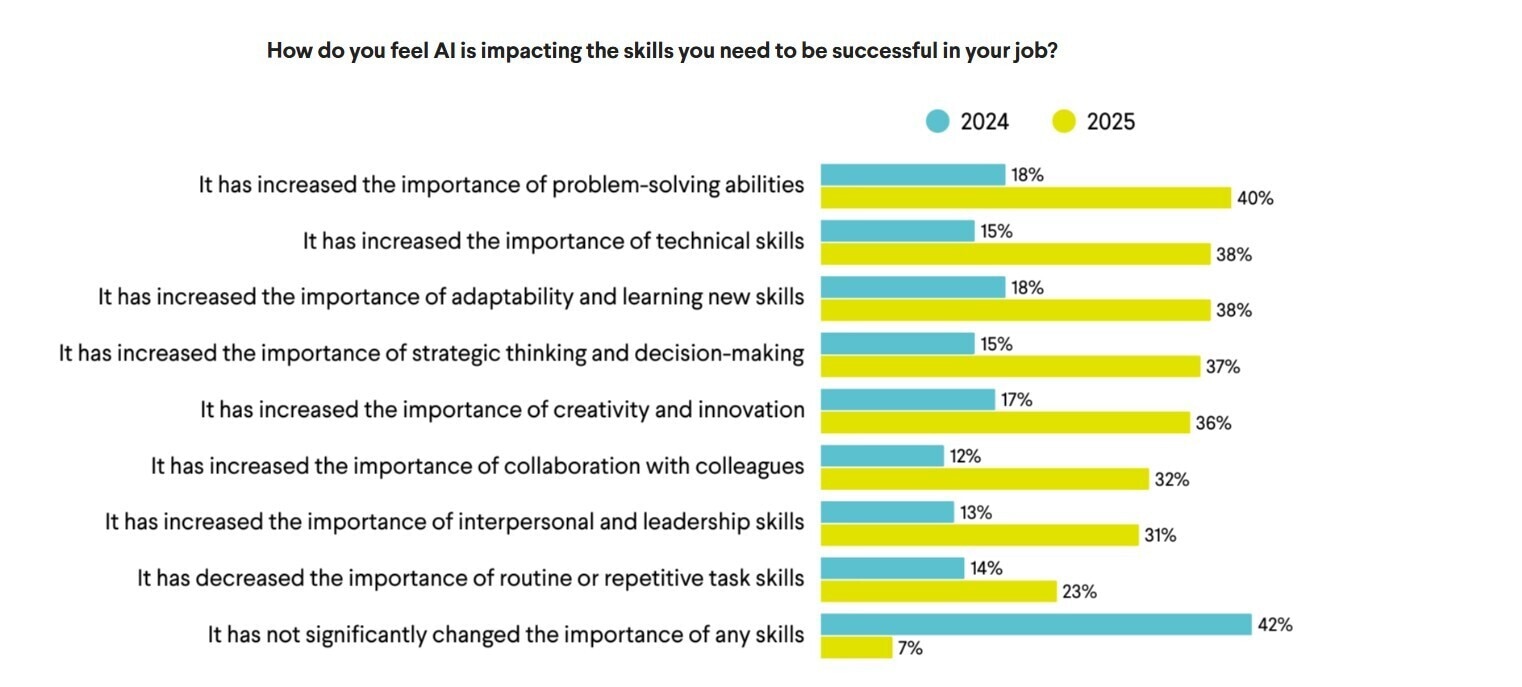
So to me, it's surprising that as AI is advancing, folks are becoming, at least in our survey findings, more sceptical of what that means. We're also seeing a lot of almost splits down the middle, in terms of how individuals and workers are experiencing AI. We see almost half and half, workers who feel they're gonna need new skills and workers who don't feel they're gonna need skills. Workers who feel they are more connected than before or less connected. And so a lot of that is really telling me that we're very much in the messy middle of AI implementation. And it's kind of the early innings of a long game, but I think it's also telling us that we need to really get this right or else these pendulums can be swinging in ways that we don't wanna see.
Linda Lacina, Meet The Leader: You talked about how the AI adoption is hitting different workers in different ways. Can you talk a little bit about that and the big gaps that could be made even bigger?
Maria Flynn, CEO, Jobs for the Future: Yes, so one thing at Jobs for the Future, we are really invested in equitable economic advancement for all. And when we think about our North Star and quality jobs, there are four big buckets of workers that we really prioritize. First, are workers without four-year college degrees; women; workers of colour; and, workers who have been impacted by the criminal justice system. So when we look at the impact of AI, we're particularly looking at the impact that it is having or not having on those population groups. And one group that really stood out in our recent findings was women. I think both in terms of we are not seeing as many women as men really engaging in AI, we are seeing women kind of express more scepticism or fear about AI and that gender gap is concerning to us. And I know that's an issue that there's been a lot of conversations with a lot of the technology firms and even at the UN, around how do we start to address the gender gap in AI, both in terms of usage and in terms of leadership in the AI space.
The more that we can really highlight the profiles of women in tech and women who are leading in the AI space, the more we will be really encouraging young women and girls to kind of be considering that as a career path.
”Linda Lacina, Meet The Leader: Some of these gender gaps in technology and also with the sciences have been in place for a long time. Are there other learnings that we can take that we can finally maybe accelerate? What can we do now to really make a change?
Maria Flynn, CEO, Jobs for the Future: That's a great point because we have seen kind of inequities in STEM fields for decades. And we do know some things that work. So one across the board is intentionality. So, really designing pathways and programmes with a diverse kind of worker set in mind. So, really be designing for that inclusion, instead of exclusion. So that can mean really thinking about how we structure gateway courses, like within colleges. How do we make those more inclusive, instead of a screening-out mechanism, really a pulling-in mechanism. So, also looking at things like cohort-based learning, we know that learners like to learn alongside folks that they can really relate to. So we've seen great outcomes with all-female cohorts or first-gen cohorts or really thinking about how that learning kind of cohort can be structured.
Also, I think just in general, a lot of people say, you have to be able to see it to be it. So they think the more that we can really highlight the profiles of women in tech and women who are leading in the AI space, the more we will be really encouraging young women and girls to kind of be considering that as a career path. So it really, it needs to start early in terms of career awareness and career exploration in middle schools and high schools, but really that policy and practice of inclusion kind of throughout undergraduate and also once in the workplace, I think are really critical. During the boot camp era, we saw programms like Girls Who Code and other kind of gender-specific programmes do a good job in terms of having women complete and get employed, but then we saw a lot of retention issues once the individual was in employment. So I think really thinking about what does inclusion and belonging look like post-placement, post-employment, is an important piece of this picture as well.
Linda Lacina, Meet The Leader: In that messy middle and helping people navigate it, what's something that maybe a worker might not be doing right now, may not be thinking about, but they really should. They should do it right away, do it in tomorrow's meeting or whatever. What's one thing they should be doing now?
Maria Flynn, CEO, Jobs for the Future: They should be open to AI. They should be taking steps to learn as much as they can to really think about how can it be making their job, their workday easier. Just in my own experience, I have two kids, one who is 13 and one who is 21, and I find that they are not getting exposed to AI in ways that I wish that they were, kind of in either middle school or as an undergraduate. And, so I think in this messy middle, really I think individuals need to be thinking about how can they be gaining these skills, building awareness, because this is more and more gonna be a reality on the job site, increasingly over the next months and years.
Linda Lacina, Meet The Leader: You have said that employers will need to be educators, not just around AI tools, but also on people skills, that people-to-people collaboration. So, I have to ask you, as long as humanity has been in existence, this has been an area of improvement. What can we do now to make this work finally?
Maria Flynn, CEO, Jobs for the Future: Yeah, so I think many researchers are saying, and at Jobs for the Future we definitely agree, that human skills are going to kind of go out of fashion. Like the humanity in our roles and in our work life are going to be what is key kind of to success in the age of AI. It's something that has really been a through line across the 30-plus years I've worked in the workforce area, like dating back to the early 90s, there was a federal commission called the Secretary's Commission on Achieving Necessary Skills, and that was really outlining skills like communication and problem solving and teamwork that they felt were really going to be the key skills of the future.
I think if we re-ran that report today, it would say pretty much the same thing. I think where we fall short is that we do not really teach those skills in a very specific way. I think making it clearer, even in elementary school and high school, we are having you do this project with a group of people, because we want you to learn how to work with others, we want you to be able to communicate, we want you to be able learn across differences.
Making it clearer what we are teaching and why and how that applies to someone's future career, I think, is something easy that we could be doing. And there's also been, I think, a kind of uneven assessment of those skills. And so really, how do employers think about assessing someone's kind of durable skills or human skills as part of their kind of advancement mechanism? So I think this is where we can kind of all agree that these skills are the right skills, but how we best embed them in our learning, really make them kind of stand out when we're doing talent assessments, is where we have a lot of room to grow.
We are big proponents of skills-based talent practices and there's been a lot of work and writing around skills- based hiring. So hiring on the basis of skills that people have versus the degrees that they do or don't have.
”Linda Lacina, Meet The Leader: What works? What are some tactics that maybe your organization has helped put into place where you're like, yes, this is a way forward?
Maria Flynn, CEO, Jobs for the Future: Yeah, so we are big proponents of skills-based talent practices and there's been a lot of work and writing around skills- based hiring. So hiring on the basis of skills that people have versus the degrees that they do or don't have.
I think we're still in the early days of that, but I think it has really promising approaches to kind of diversifying the workforce and really helping workers find the workers that they need at any given time. We would really advocate going beyond that and to really be thinking about skills-first practices throughout the talent life cycle. So, meaning how can we be advancing folks in the workforce based on the skills that they have? How do we help managers kind of shift their mindset to kind of really base their assessments on skills and give them the framework to do that?
So, there are a lot of great tech platforms out there. There's one that we invest in in our venture arm, JFA Ventures, called Adept ID, for example, that can really help employers put a common language in place and a common protocol for really identifying the skills that are most important for any occupation and how you're assessing your workers against those skills. So it goes beyond just a worker self-reporting what they're good at, which is important and a piece of the puzzle, but how do you make this kind of a more rigorous part of your talent practices throughout?
Linda Lacina, Meet The Leader: Which kind of brings us to our Chief People Officers Outlook, which is a big survey that the World Economic Forum has done with the chief people officer community that we have and one of the big themes of that report, one of big hard realities that we have to face is that it says there's not necessarily a talent shortage, but there is a skills mismatch, right? And so, right in this AI era, why is fixing this so critical? If we don't do this now, what happens in ten years?
Maria Flynn, CEO, Jobs for the Future: I think this is a critical issue right now because, to me, the issues of AI and the issues of skills go hand-in-hand on a number of levels. One, I think that the advancements in AI are going to change the skills needed for almost every occupation. So, there's going to be a shift in skills that we see across the board, an increase in some, a decrease in others, maybe new skills altogether that kind of come on the scene. But we also, I think, given how quickly these changes are coming, it's also gonna make it more important for employers to be thinking about skills as the currency of their workforce.
To instead think that, oh, well, we have these MBAs or we have this policy-folks with graduate degrees, it's really going to really come down to the nuance of what specific skills are needed, how we test for those, how we assess those, how we can train folks in them quickly. Because I think, as we're seeing, many people are going to need to be reskilled or upskilled, but I think this era of reskilling and upskilling is going to look very different than what we saw, for example, after the 2008 financial collapse. This is going be less about someone going back to get a new credential over the course of six or 12 or 18 months. It's going to be much more about rapid learning of new skills. Often through kind of new technologies. So, really then, also thinking about how does AI and AI-enhanced learning help us kind of articulate the skills that are needed and help us access kind of the information we need to enhance those skills. So AI and skills, I think, are going to have a very strong interplay across a number of different axes.
Linda Lacina, Meet The Leader: Skills-based hiring, there's been growth and some improvements in some areas, but how do we really scale it? What do you think we really need?
Maria Flynn, CEO, Jobs for the Future: Where we see kind of some of the holdups is around skills-based hiring. So, first, I would say some good things we are seeing, for example, the majority of states have removed degree requirements from state jobs. So that's a great example of policy changes that can help get to kind of adoption at scale. But where we're seeing some of the roadblocks is really around kind of culture, mindset, you know, of hiring managers in particular. And if you look at some surveys, almost all CEOs will say they're in favour of it, but then when you get down to kind of hiring managers, there's less positive reception, I think, to the idea.
So it's really, I think, again, comes back to culture change. How do we show that this is a practice that can kind of help across the board? It can help the worker. It can help the business. It can help regional economies. But it's really, I think, that culture change, which is where we need to focus in order to make this scalable and also, I think, looking at this type of change in parallel to what's happening within workplaces around AI. So I think being able to look at both of these things in tandem, I think can also help kind of accelerate adoption.
Your first job is not going to be the job you have forever, but yet every job, including that first job, can really give you a wealth of information and experience and skills that you can build upon.
”Linda Lacina, Meet The Leader: Given all this, young grads are going to be entering the workforce very, very soon, in a few months. What is the most important advice that no one is giving them? What do you want them to know to drive home? What should they be doing?
Maria Flynn, CEO, Jobs for the Future: My oldest daughter is graduating in May, so I am living this in real time and talking with her and a lot of her friends. I would say two things really come to mind. One is where you start is not gonna be where you finish, right? So, it's like understanding that even in the best of times, that first job is likely not going to be your dream job. And I even say to my daughter, you know, I wasn't a CEO coming out of college, you know, I was an entry-level government worker working with, you know, five other women in Philadelphia. You know, it was not a glamorous lifestyle, but wherever you start, really be sure that you are learning from that experience, both in terms of really identifying the skills that you're learning, identifying what you like and don't like about that experience and how that can help you guide you to your next thing. So it's really understanding that nothing is forever, right? Your first job is not going to be the job you have forever, but yet every job, including that first job, can really give you a wealth of information and experience and skills that you can build upon.
I don't think that a four-day work week is one that we are going to see adopted at scale anytime soon. I don't think that the conditions are right for that.
”Linda Lacina, Meet The Leader: We're gonna do a fun, rapid response game here. A little game I like to call Red Light, Green Light. I give a special future of work trend and Maria will hold up a red card and a green card, letting me know which trend she thinks will move forward. Red card being stop, green card being go. First trend on the docket, we'll finally get a four-day work week. Let the record show Maria is holding a red card. Tell us why?
Maria Flynn, CEO, Jobs for the Future: Given how long it takes for any workplace reform to take hold and to scale, I don't think that a four-day work week is one that we are going to see adopted at scale anytime soon. I don't think that the conditions are right for that, basically.
Linda Lacina, Meet The Leader: The white-collar job is over and we should all become plumbers?
Maria Flynn, CEO, Jobs for the Future: So, I think skilled trades jobs are critically important and we need many more workers to become interested in those roles and take them on. But I don't think that means that we all need to be going down that path. I think there are gonna continue to be a rich mix of jobs that are out there. They may not be the exact jobs that we see today, but there are still going to be high-quality jobs across the kind of white and blue-collar spectrum. And I think what's gonna be important is that we have robust career navigation systems that can help workers really make the choices that really are best for them.
Linda Lacina, Meet The Leader: Specialists, not generalists, will be the kings in the AI era. I'll let the record show we have a green card. She said, yes, specialists will have the advantage. Tell us why?
Maria Flynn, CEO, Jobs for the Future: I think AI is going to make it easier for everyone to be generalists in some way. I think that baseline information will be more accessible. You won't have to kind of go and take a college course on, you know, something. You will be able to kind of get that information and kind of become an expert on your own in a much more generic and kind of like ongoing way. I think it's folks who are going to be able to kind of use that baseline of general knowledge and augment that with specialized skills and information and kind of analytics that are going to be kind of the most in demand in the future.
Universities are going have to be adapting how they are preparing young people for the world of work. They're going to have be embracing more experiential learning and work-based learning opportunities and to be embedding kind of that career navigation and career awareness more into their core curriculum.
”Linda Lacina, Meet The Leader: The four-year degree is obsolete. Yes or no?
Maria Flynn, CEO, Jobs for the Future: Not yet. I think that four-year degrees are going to continue to be important, but I think, number one, we're going to see more openness to skills-based hiring and kind of looking at hiring in new and different ways. I also think that four-year universities are going have to be adapting how they are preparing young people for the world of work. They're going to have be embracing more experiential learning and work-based learning opportunities and to be embedding kind of that career navigation and career awareness more into their core curriculum. So I think four-year degrees will remain; they will be important, but they're gonna have to look different and they're going to be one of many high-quality options that will be available to learners and workers.
Linda Lacina, Meet The Leader: Liberal arts majors will finally step into their power. Red or green? We have a red card. Tell us why?
Maria Flynn, CEO, Jobs for the Future: I am a liberal arts major. Again, I think liberal arts majors are critical and they are, those majors are great ways of learning kind of a lot of those human kind of fundamental skills, but I think unless we can also be equipping those majors at the same time with strong knowledge of the labour market, really helping them see how to apply those skills in real-world settings, they're going to continue to be a little too traditional and ivory towerish and not as agile and real world as we need in today's economy.
We are gonna finally fix the skills mismatch because advances in AI are going to force us to.
”Linda Lacina, Meet The Leader: Last question. We will finally fix the skills mismatch. I love it. We have a green card. Tell us why?
Maria Flynn, CEO, Jobs for the Future: I think we are gonna finally fix the skills mismatch because advances in AI are going to force us to. So, I think in some ways, advancements in AI and how fast it is moving are going to make it critically imperative that we really get on top of our game and kind of solve these mismatch issues when it comes to kind of supply and demand and the skills that connect those two key features of the labour market.
Linda Lacina, Meet The Leader: That was Maria Flynn. Thanks so much to her and thanks so much to you for listening.
If you know someone wondering what's ahead for AI and skills, send them this episode. If you really want to help them, let them know that this is part of a series on HR leaders digging into the biggest trends they're facing.
I mentioned our Chief People Officer's Outlook. I will have a link in our show notes.
This episode of Meet the Leader was produced and presented by me with Jere Johansson as editor, Yves Schaffner as studio engineer in New York and Gareth Nolan driving studio production. That's it for now. I'm Linda Lacina from the World Economic Forum. Have a great day.
New research shows many labor markets face a skills mismatch, not a talent shortage. And in the 'messy middle' of the AI transformation, that mismatch will be harder for leaders, workers and hiring managers to ignore as they build future-ready teams. To compete, companies will need to focus less on classic degrees and more on skills-based hiring to ensure worker capabilities reflect what rapidly evolving roles require. In this episode, Maria Flynn, CEO of non-profit Jobs for the Future, explains why education and workforce systems built for the past are struggling to keep pace with AI-era job shifts requiring changes in how workers are trained, assessed and tested.

世界の課題を読み解くインサイトと分析を、毎週配信。

Richard Florida, Vladislav Boutenko and Drishti Sharma
2026年8月17日