Technology Convergence: The New Logic for Competitive Advantage


Technology convergence is changing how competitive advantage is created. As technologies increasingly combine, the opportunity is no longer just identifying promising pairings, but scaling them for real-world use. This second edition of the Technology Convergence Report shifts focus from where combinations emerge to how they create value.
Written in collaboration with Capgemini, the report explores how organizations turn technical promise into operational impact across industries. It shows how convergence reshapes value chains, shifts bottlenecks and changes where value, power and risk sit across the ecosystem.
The report finds that the winners are not always the most technically advanced, but those best able to integrate new systems into existing workflows, work effectively with partners and translate coordination into repeatable deployment, adoption and monetization. It offers leaders a practical lens for building advantage in a world where convergence is no longer a technology trend, but a new operating logic.
Key findings
Orchestrating multiple technologies is critical to scale, ensuring convergence delivers real impact
Convergence is more than combining technologies, it is a way to break through the bottlenecks that slow industries down. When done well, it unlocks capabilities that feel like step‑changes, not increments. But advantage doesn’t come from buying the instruments, it comes from conducting the orchestra. The organizations that win do not need to be the most technically complex, but the most able to integrate, coordinate, and execute. The following actions show what it takes to turn convergence from potential into performance.
Key insights from the report include:
1. Convergence can overcome critical bottlenecks, but only when anchored to the problem
Combinatorial technologies scale when they address a key bottleneck without introducing a new equally limiting one. This requires strong anchoring to the problem when creating new combinations. The maturity index can help identify new combinations, where mature technologies provide a stable foundation for combining with novel emerging solutions.
Example technology combinations underpinning surgical robots:
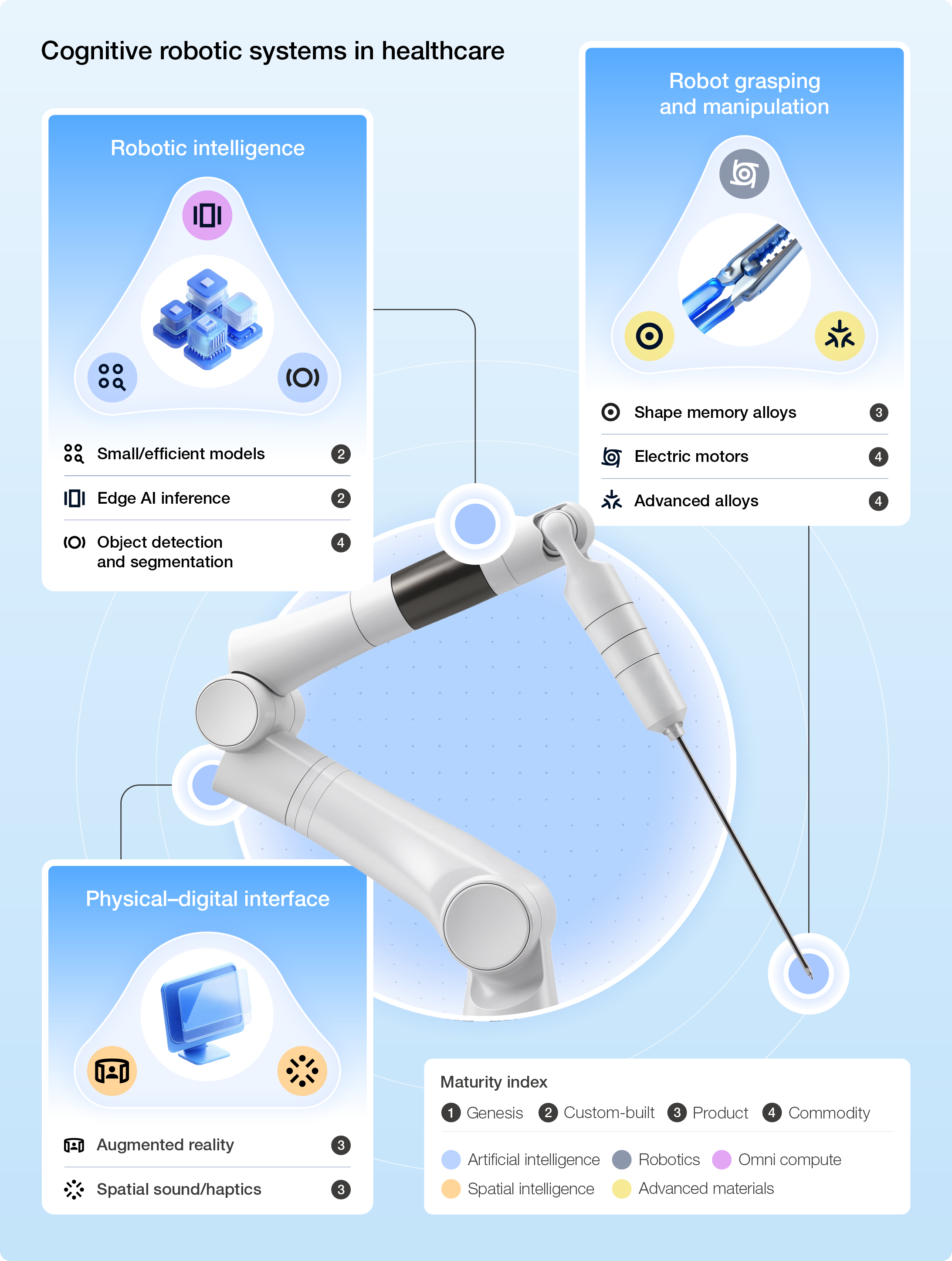

The figure shows how technologies from diverse domains and maturity levels combine to create surgical robots
Organizations should use the maturity index to identify the combination most capable of relieving their core bottleneck, without a new equally limiting constraint emerging.
2. Breakthrough value is emerging at the physical–digital interface
A consistent theme across the industry analysis is that convergence turns the physical–digital merge into a source of competitive advantage. AI acts as the key enabler, transforming real‑world data into meaningful strategic value. Organizations can strengthen this advantage by ensuring that the link between the physical and digital worlds is designed for continuous learning. In areas like surgical robotics, digital twins and smart grid systems, first movers succeed by taking on the burden of bridging this divide themselves, removing that complexity for the customer.
Organizations should use advances in AI to tightly connect sensing to simulation, for real‑world execution.
3. Scaling convergence is now a leadership and operational challenge as much as a technical one
Technical capabilities alone do not determine success. Convergence scales when it can integrate across technologies, ecosystems and processes in which it operates. Surgical robots designed to fit existing operating rooms were adopted quickly. Similarly, digital twin tools were adopted when factories could plug into their current data and workflows. The industry winners are not always the most technically advanced; they are the most ready to integrate.
Leaders need to lower the barriers to adopting new convergence solutions by assessing their interactions with people, processes and ecosystems.
4. Convergence reshapes value chains, requiring organizations to adapt in how they create and deliver value
Convergence does not simply improve products; it reconfigures entire value chains. Across the five domains explored in the paper (surgical robotics in healthcare, digital twins in manufacturing, intelligent grid systems in energy, autonomous labs in life sciences and non‑invasive BCIs in human–machine interaction), common structural shifts emerge despite very different industry contexts.
As technologies converge, traditional bottlenecks move and new activities become central. In healthcare, value extends upstream from intraoperative skill to pre‑operative planning and procedure design. In manufacturing, generative design shifts effort from manual ideation to evaluation and selection. In energy systems, intelligent grids reduce distribution constraints and enable new forms of energy production to be incorporated.
Example digital value chain change:
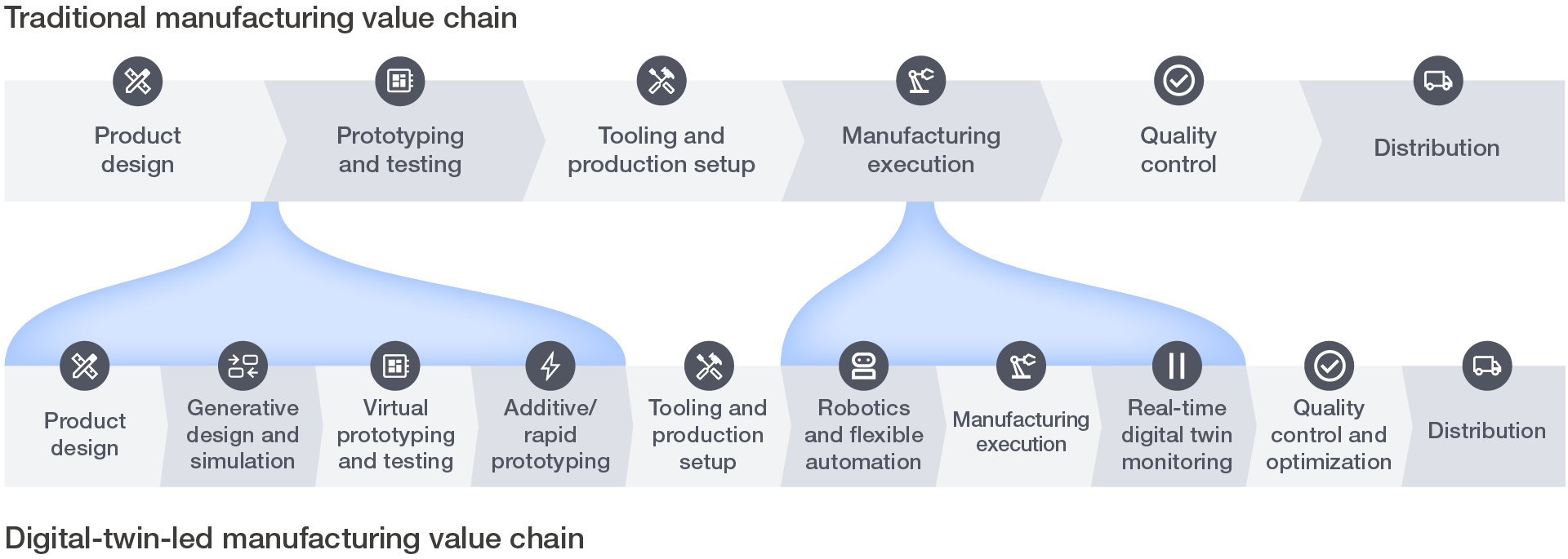

The figure shows how digital twins transform the traditional manufacturing value chain.
Across sectors, competitive advantage increasingly shifts from owning assets to coordinating capabilities across complex systems. As these systems deliver value continuously, many successful organizations shift to service-based delivery.
Once convergence solutions start to scale, maintaining the advantage requires organizations to assess if there is opportunity to redesign how value is created to extend what people can achieve.
5. When scaling convergence, competitive advantage shifts to orchestration
Across all sectors studied, organizations that translated convergence into lasting advantage did so by linking systems, people and partners. This orchestration capability consistently took three forms:
- Work across boundaries: Align teams, workflows and data across organizational boundaries, recognizing that no single organization can build or own the full convergent technology stack.
- Set a common language: Establish shared standards, interfaces and governance so technologies and partners can interoperate predictably at scale.
- Transfer proven capabilities: Accelerate convergence by repurposing mature capabilities from adjacent industries instead of building everything bespoke.
Focus on enabling the ecosystem by systematically reducing friction across the organization’s interconnected partners and capabilities.
The race to compounding advantage
Combinations create opportunity, but scale determines impact. Advantage emerges when individual combinations are integrated into systems that reliably work across people, processes and ecosystems. Organizations that internalize the combine–converge–compound dynamic move beyond isolated capabilities to orchestrated learning and coordination, where each deployment strengthens the next and sustains advantage over time.