The United States has reported the first case of a person carrying a bacteria resistant to an antibiotic of last resort – a development that could mean “the end of the road for antibiotics”.
Scientists have found a strain of E. coli resistant to colistin, an antibiotic reserved for the hardest-to-treat bugs, in a 49-year-old Pennsylvania woman, according to a study in the journal Antimicrobial Agents and Chemotherapy.
The authors wrote that the discovery “heralds the emergence of a truly pan-drug-resistant bacteria”.
The news comes as British Prime Minister David Cameron told G7 leaders in Japan that countries needed to do more to combat killer superbugs by reducing the use of antibiotics and providing incentives to drug companies to develop new antimicrobial treatments.
"In too many cases antibiotics have stopped working. That means people are dying of simple infections or conditions like TB (tuberculosis), tetanus, sepsis, infections that should not mean a death sentence," he told a news conference at the G7 summit.
"If we do nothing about this there will be a cumulative hit to the world economy of $100 trillion and it is potentially the end of modern medicine as we know it."
How close are we to a post-antibiotic era?
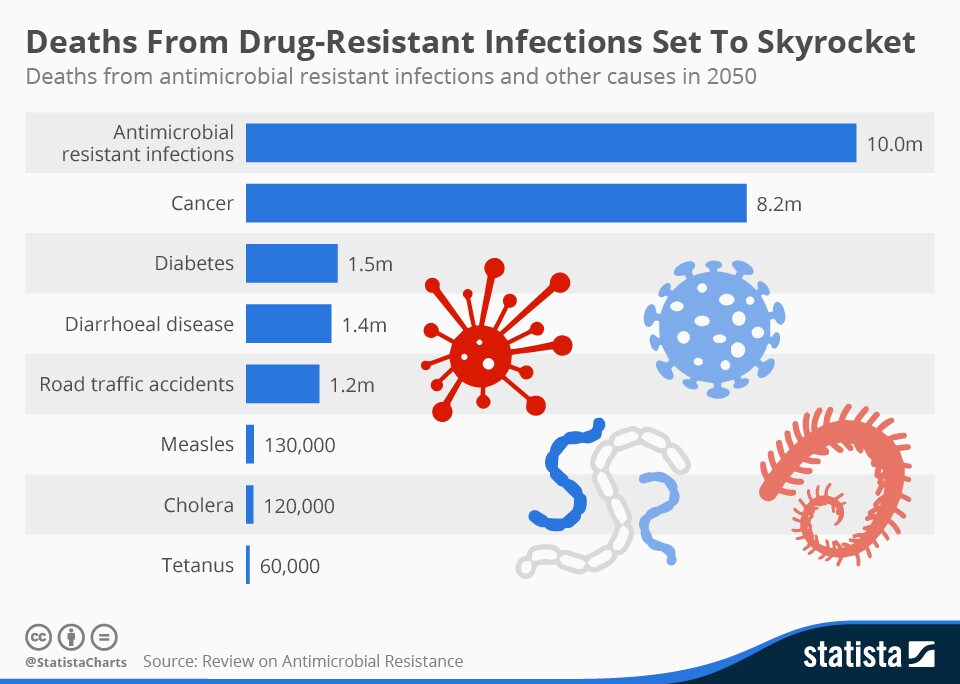
Around 700,000 people die each year from drug-resistant infections. A review commissioned by the British government warned that if the world fails to get to grips with the problem, an extra 10 million people a year will die by 2050.
This is the first time a colistin-resistant bacteria has been discovered in a person in the United States. But last November, scientists found a colistin-resistant strain of E. coli in pigs, raw pork meat and in a small number of people in China. The strain was later found in other parts of the world.
"The more we look at drug resistance, the more concerned we are," said Thomas Frieden, director of the US Centers for Disease Control and Prevention.
"The medicine cabinet is empty for some patients. It is the end of the road for antibiotics unless we act urgently."
What can we do about it?
The World Health Organization says there are ways to fight the tide of antibiotic resistance. If all countries adopted good practices for the prescription and use of antibiotics we could see a decline in the numbers of deaths caused by antibiotic-resistant infections.
We can also prevent infections from happening in the first place with better hygiene, access to clean water, infection control in healthcare facilities, and vaccination to reduce the need for antibiotics. The WHO is also calling for new diagnostics, antibiotics and better tracking of drug resistance.
Drug firms have been accused of failing to invest enough in the search for new antibiotics. But the superbug threat is prompting action: in January, 83 companies, including Pfizer, Merck & Co, Johnson & Johnson and GlaxoSmithKline, signed a declaration urging governments to support the development of new antibiotics.
Have you read?
Superbugs: how worried should we be?
Will we ever create resistance-proof antibiotics?
Is the world on the brink of a post-antibiotic age?