
Do you trust your boss? Your employer? Your colleagues?
Probably not, says a new report from EY.
In a survey of nearly 10,000 full-time employees in eight countries, less than half said they have a ‘great deal of trust’ in their colleagues, boss or employer.
The global picture
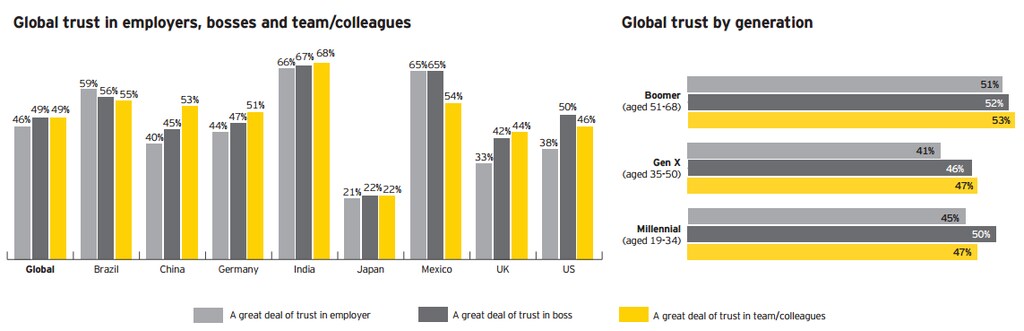
There are major differences around the globe. In Japan, fewer than one in four people have a great deal of trust in their employer, boss or colleagues. Compare this to India, where more than two-thirds have a great deal of trust.
There is also significant variation in whom people trust most: their employer, their boss, or their colleagues. In China, Germany, India and the UK, it’s colleagues. In Brazil, it’s employers, while in the US it’s bosses.
There are interesting generational differences in trust. Baby boomers are the most trusting generation, with Generation X being the least. The most significant differences surfaced in China, India and Mexico, write the report’s authors.
So what’s driving this lack of trust?
There are a number of factors at play.
When it comes to trusting our employers, pay has a significant influence. More than half (53%) of respondents said ‘employee compensation is not fair’.
Bosses are held back by a variety of factors linked to poor communication, including a lack of open or transparent communication and timely, constructive feedback.
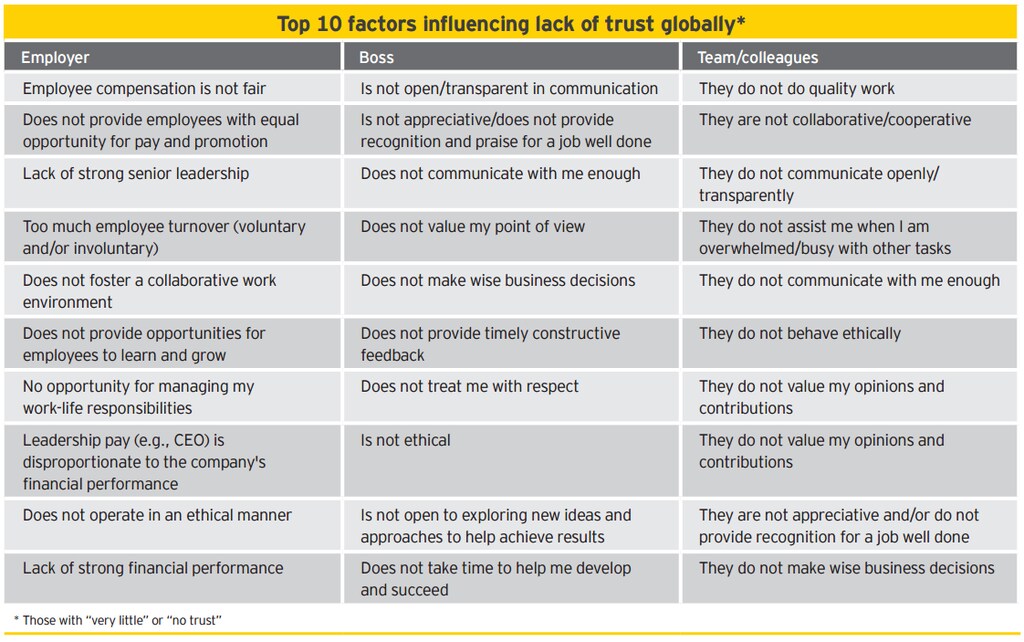
Quality of work is the biggest factor driving a lack of trust in colleagues. A lack of communication and collaboration were also named as issues.
The result? A low level of trust would drive 42% of respondents to look for a new job. Nearly a third would only do the minimum number of hours, while over a quarter would be less engaged and productive.
Can businesses do anything about it?
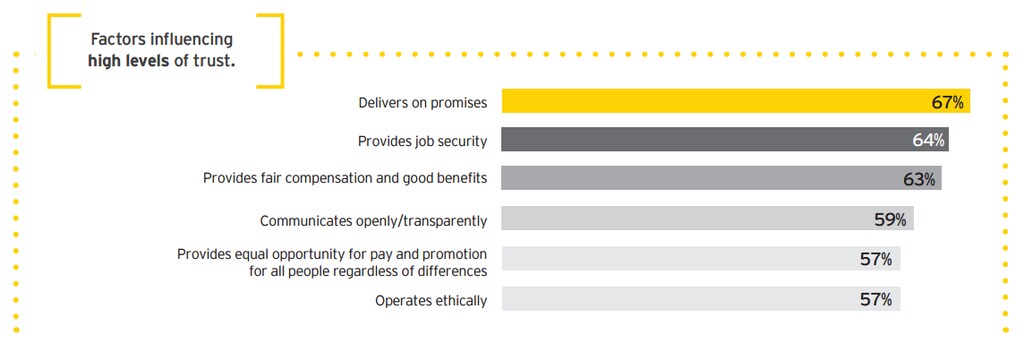
The report suggests a number of areas that can help to generate trust. Two-thirds of respondents see delivering on promises as an important factor.
Job security and fair compensation and benefits are also important for around two-thirds. Communication and ethics play a role for more than half of those involved in the survey.
Increasing trust makes good business sense as well, say the authors. Workers say if they had high levels of trust they’d be more likely to be ‘happier in their jobs’, ‘do higher quality work’ and ‘recommend the company to others’.