ポッドキャスト・トランスクリプト
This transcript has been generated using speech recognition software and may contain errors. Please check its accuracy against the audio.
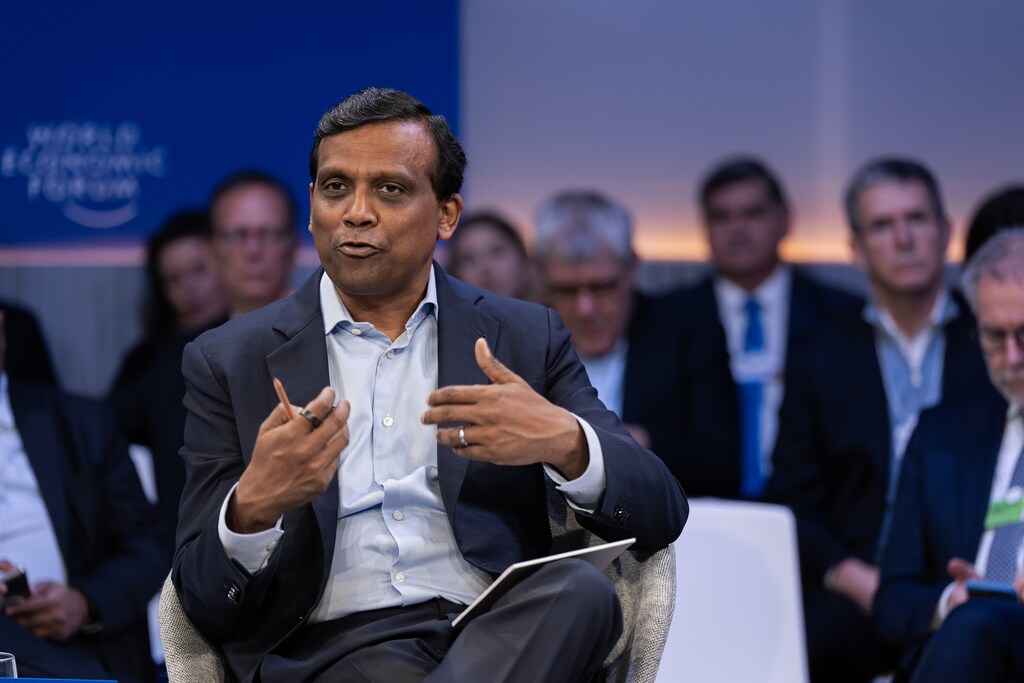
Ravi Kumar, CEO, Cognizant: The business models of today, the talent models of today, the jobs of today are all going to reforge themselves into new jobs, new tasks.
So I would say the single biggest shift with AI is that foresight is completely fogged.
Robin Pomeroy, host, Radio Davos: Welcome to Radio Davos, the podcast from the World Economic Forum that looks at the biggest challenges and how we might solve them. This week: what impact will artificial intelligence really have on our jobs and the education and training systems needed to prepare current and future generations?
Ravi Kumar: The jobs of the past are moving out very quickly and the jobs of the future are coming at a slower pace.
Saadia Zahidi, Managing Director, World Economic Forum: There's a minimum of that 11% of the current world's workforce that will need support in a managed workforce transition to probably an adjacent industry, if not a wholly different industry.
Robin Pomeroy: Ravi Kumar, CEO of technology services company Cognizant, says while money pours into AI tech, it also needs to be flowing into education and training.
Ravi Kumar: Re-skilling should be a part of the infrastructure stack. It cannot be done on the side. You have to look at it with the same lens as you look at it for compute, for LLM access, you have to make reskilling a part of the infrastructure stack.
Robin Pomeroy: And World Economic Forum Managing Director Saadia Zahidi says no one should doubt that change is happening fast.
Saadia Zahidi: Things are moving perhaps a little bit slower than we might have all thought a couple of years ago, but then on the other hand, they're still moving a lot faster than our current systems are designed to address.
Robin Pomeroy: Follow Radio Davos wherever you get podcasts. I’m Robin Pomeroy, and with this look at the real impact of AI on all our jobs...
Ravi Kumar: How do you integrate that into everything you do?
Robin Pomeroy This is Radio Davos.
Artificial intelligence is already having an impact on the way most of us work - but it’s still early days and it's hard to predict exactly which jobs will disappear completely, what new ones will be created, and when and where this will happen.
It’s a subject that's important to all of us - so my colleague Gayle Markovitz spoke to the head of an AI services firm, Ravi Kumar of Cognizant, and to the head of the World Economic Forum’s Centre for the New Economy and Society, Saadia Zahidi. Both have unique insights into the impact of AI on the economy, on employment, and the implications for education and training.
Gayle started by asking Ravi Kumar for his assessment of AI’s impact.
Ravi Kumar: One thing is certain, AI has created a fog on the foresight.
Modern businesses, modern finance has been built with this assumption that we've got to have long, slow bets. And with the fog around us, that foresight is broken.
And those long, slow bets are no longer valid because the models, the business models of today, the talent models of today, the jobs of today are all going to reforge themselves into new jobs, new tasks, new job families.
So I would say the single biggest shift with AI is that foresight is completely fogged.
Having said that, I think we have this unique opportunity to re-pivot, a future which is more shared prosperity and we could re-pivot in a direction where the drift of value coming out of AI goes into the front lines.
Over the last 50 years, technology has drifted that value upwards, and the frontlines have actually been kind of, not actually had that value shift, and therefore we have created a level of divide. I think we have this unique opportunity to re-pivot and drift that value downwards, capability downwards. And we hope that value actually moves downwards as well, so that you have more wages for the frontline workers.
That's what I'm hoping so. And that's what we believe. We have a very nice opportunity to, you know, reset the whole future of workplaces and workforce.
Gayle Markovitz: Saadia, why would you say this is a global problem rather than a company by company issue?
Saadia Zahidi: I think what Ravi said is just so spot-on both at a micro level and at a macro level.
And maybe just building on that, maybe there's three big reasons that I guess we tend to think of this as something that is a global challenge I'm not sure it's fully a problem. I think there's a huge opportunity here as well.
But one element is of course that we found that the bet that's been placed on AI and the massive amount of investments, the time to productivity gains is somewhat slowing down, which means that there is a very interesting window in which to make the equivalent workforce transitions if we want those productivity gains, but also be able to do that in a way that people can sort of absorb and manage.
I think the second element is that there's society level concerns that have to be solved for because not every organisation will be able to manage this by themselves.
What we found in one of our last reports, and we'll do an update later this year, is that if the world's workforce was 100 people, 11 of them would not be able to re-skill and redeploy in their current organisation. Which means there's a minimum of that 11% of the current world's workforce that will need support in a managed workforce transition to probably an adjacent industry, if not a wholly different industry.
So there's a set of support that is needed between the public and the private sector there.
And then finally, the third element, just again at that very big picture level, is that AI is not the only trend and it is interacting with a number of other trends that include all of the geopolitical and geoeconomic shifts we see, and that include the demographic shift.
So let's take the demographics piece. There is that opportunity here for many of the world's workforces where there actually is a reduction in talent over the long-term due to ageing or shrinking workforce, there's an opportunity here to integrate artificial intelligence in a very different way. And equally so, there's an opportunity for AI tools to actually support and up-skill talent in many parts of the world where education systems have not been able to keep up with the needs of many young populations.
So again, it's a complex picture, but I think there are some broad global implications that go beyond what is happening inside each organisation.
Gayle Markovitz: So Ravi, I know that Cognizant has recently conducted some new research on AI and jobs. And it's revealed some changes that you hadn't predicted. What was the statistic that stood out that really surprised you?
Ravi Kumar: We did a research in 2023, and we did another research in 2026, early 2026. We also partnered with the World Economic Forum to do some joint research as well.
You know, when we did this in 2023 we expected impact on every job, and when I mean impact on every job, the job by itself changes in form, the tasks underneath change, some of those jobs will remain, but they will reforge in a different direction, and there'll be new jobs.
90% of the jobs we actually in 2023 said will actually get impacted by AI, at least 10% of those tasks by 2030. And here we are in 2026, 93% of these jobs when we did the second survey in 2026, we realised that they have actually got impacted.
We took almost 18,000 tasks, a thousand occupations, and we kind of, you know, conducted that research on those occupations and on those tasks.
What is fascinating is the velocity of change has significantly changed. You know, what was supposed to happen in 2030 is now happening in 2026. We saw the velocity of changes at around 9% every year. 50% exposure to jobs, where there is, you know, you would actually believe that the jobs have changed tectonically, 50% of exposure, 30% of the occupations actually have gone through that. 25% exposure, where you actually have those jobs reforged in a different direction, we almost, we almost saw 56% of the jobs going through that kind of change.
So most of these jobs we have today, those occupations are going to reforge in a different direction. Some are jobs which are going to be futuristic. In fact, we believe AI is going to be in the middle of a flow. They're going to be a lot of jobs on the front and a lot jobs on back. The ones on the are related to authentication, problem finding, creativity. The ones in the back are going to the validation, verification, judgement, accountability, outcomes. So you're going to see a lot of those jobs.
So the asymmetry is not going to be about expertise and intelligence. The asymmetry is going to come from applying that intelligence and including that intelligence as throughput into your input factors on a job.
I'm actually fascinated by the opportunities which this uniquely presents to us. You know, look at it this way. If you're going to create more throughput, more productivity on the front lines, you're going to actually shower more wages. Per capita wages have not gone up for the last 20 years if you if you adjust it to real inflation. Now, wages go up because throughput goes up and you're going to get significantly higher output without inflation, it's a good thing for economies.
The point is, how do you drip that capability downwards? How do you push more throughput downwards so that there is an incremental wage and higher throughput? That's what we are looking for.
So this research tells us that it's coming at rapid pace. The capability is right out there. The production value in enterprises is way below. And this is what Saadia was referring to. The production value is way below the capabilities out there. There is a big bridge. So we have a unique opportunity on that bridge to build, you know, workforce skills and re-skill our workforce so that the production that you can go up.
And we need the production very to go up because the technology, you now, you know this, in the last 12 months, a trillion dollars has been invested into AI infrastructure. The scaling loss for this infrastructure is only six months, which means in six months it goes obsolete. So the faster you could actually drip that value to enterprise production value, the better it is.
And to drift that production value and bring it to the same level as capability, you will have to re-skill the workforce. I've actually said this in the WEF research we jointly did that re-skilling should be a part of the infrastructure stack. It cannot be done on the site. It has to be a power of the infrastructure stack. You have to look at it with the same lens as you look at it for compute, for LLM access, you have to make reskilling a part of the infrastructure stack.
Gayle Markovitz: What does that look like, especially for say a non-tech organisation, what does that mean in practise? And I'm interested also that you use language like bridge, because it really is like building something.
Ravi Kumar: The reason why this production value is significantly lower than the capability, I mean, the capability will keep going up. So the bridge is actually going to be broadened. And you know you have to keep bridging it and I call it the velocity gap.
And the reason is very simple. You know, we can't apply this technology on old stuff in businesses. You have to reinvent flows. You have to re-invent the ability to integrate digital labour with human labour and to reinvent and reimagine business models, operating models and business flows.
This technology is very contextual. The classical software we wrote in the last 50 years was very deterministic. We codified it. A lot of the balanced things we in a workplace, in the flows of a business, are very contextual, they're judgement oriented. You have to ground this technology into the hustle of the company.
We call it a science called context engineering where we put the guardrails, we, you now, we put the harnesses needed for this technology to be productive and it has to work in sync with human effort and it to be integrated.
So all that work really means you have to reinvent those businesses. And therefore, I believe that bridge is very important.
And you will then have to redesign jobs. You will have to redesign the flows of jobs. You have redesign tasks which are done by people and how they're integrated with what is done by digital labour.
We did a good, nice landing spot on this and the bridge, I feel, has to be smoothened a little bit because the jobs of the past are moving out very quickly and the jobs in the future are coming at a slower pace. So in between the two, we have to create a bridge.
In fact, I wrote this thesis that you should tax to a large extent digital labour which is eliminating tasks versus amplifying human potential. And that's a temporary bridge, the temporary bridge of taxing the capital so that there is a little bit of a level playing field between human effort and digital effort.
I mean, remember, capital got a free runway because it actually created more wages and more jobs. Now if capital is creating digital labour and human effort, and human labour, and work, and jobs of the future are coming at a slower pace, you need a nice landing spot. So, you know, one of the suggestions I had is to look at capital taxation in a slightly different way in a short term and use it as a smooth landing spot
Gayle Markovitz: It sounds like a huge challenge for human beings to kind of come up to speed with that gap. Is this is there some good news? Is there something? I know there's been research, Saadia, there have been some misconceptions about the time it takes, for example, to upskill.
Saadia Zahidi: Yeah, so actually in the research that where we partnered with Cognizant there we found that it is not quite as prohibitive as people may think to have a base level of understanding when it comes to AI and big data, so roughly through 30 hours of study.
But of course, to become more proficient, then you're talking about 137 hours or obviously a lot more depending on the level of depth that you want to get into.
But I say that to note that, again, in some of the cross-industry surveys that we've done, one of the fastest rising in demand skills is AI and big data. But no one is suggesting that that needs to be at a level of depth. It's simply the ability to be able to work with and understand technology.
And what also comes through over and over is that the organisations that are likely to be the most successful are the ones that will be able to combine artificial intelligence with human judgement. And that means there's still a huge premium on creativity and collaboration and interpersonal dynamics and leadership skills and social influence skills. So all of that combined with then the ability to understand.
So I think it's increasingly that you won't see two completely different tracks. You will need to bring some of that together.
So I think, just adding to what Ravi has said, that's what's going to be needed, but this is where some of the pain points come in.
So things are moving perhaps a little bit slower than we might have all thought a couple of years ago, but then on the other hand, they're still moving a lot faster than our current systems are designed to address.
And so, that is where most organisations will need to move forward very quickly in thinking about, as Ravi said, workflow redesign, but then very quickly thinking about what are then the consequences for the people that are currently attached to a set of occupations that will go through a lot of change.
And then at a policymaker level, I think something very similar does need to be done as well. And that's where the piece comes in where there is simply no way for each organisation to handle this separately.
And then there's the other pieces around, how do we fund this? And that where there are ideas such as what Ravi has mentioned, and there's also some other ways in thinking about how to do this. Because of course, the costs of re-skilling and up-skilling are also going down because of artificial intelligence. And the ability to personalise that learning and re- skilling and upskilling. Are also, that ability is just so much higher with artificial intelligence.
So there are some ways to turn this technology and its disruptions into an advantage when it comes to speeding up re-skilling and up-skilling.
Gayle Markovitz: A follow-on question from that is, given it's so much more fluid to upskill and re-skill, do you think expertise will be in some ways democratised, as a question to Ravi, does it mean that we're all going to become generalists?
Ravi Kumar: I think what's going to certainly happen is there's going be diffusion of this technology much deeper downwards.
That's because the interface is natural language, unlike in the past when you needed digital skills to access technology. This is kind of democratising that process.
You know, we had this distinction of a producer of software and a consumer of software. That line is blurring. Everybody can be a producer and a customer, which means you could build your technology and allow it to amplify yourself.
So expertise in some ways is going to be on your fingertips, which means the asymmetry we created over the last 50 years based on expertise. We created asymmetry with individuals. We created asymmetry with organisations. That isn't asymmetry anymore.
The asymmetry will come from interdisciplinary skills. You should be a biologist with the ability to use agentic to improve your throughput, improve your output. You should a historian to have four clock terminals around you to be a futurist. You could be a chartered accountant having a bunch of AI agentic work around you to power your insights.
That is the future we are all looking for, which means the ability to absorb this as an interdisciplinary skill is much, much easier as Saadia pointed this out. It's much relatively easier in comparison to what we did in the past because expertise was really the symmetry. The symmetry now is interdisciplinary skills.
We need this intersection between a domain, business operations, and technology. And I think that is much relatively easier, including the fact that you would also use AI to create a personalised, micro-personalised tutor.
I mean, we now have this unique opportunity to have a tutor and a nurse for each individual, each person on the planet at a throwaway price. That's the power of this technology.
I think we have to pivot this to these meaningful, purposeful use cases, which will support this process.
You know, over the last 50 years, the drift of value went upwards. We created layers of white-collar jobs. We captured value there, and we created premium on wages. If you're pushing that downwards, a nurse in a hospital, a frontline worker in manufacturing, they would have this capability. But the way you have to design the workflows, the way you design organisational structures is you have drifting the capability downwards. It doesn't necessarily increase wages. You have to drift the value downwards as well, because value actually follows controls. It doesn't follow access.
Once you do that redesign, then the asymmetry will shift to judgement, accountability, and outcomes. And once you have judgement, accountability, and outcomes on the front lines, you're obviously going to pay more wages. And so there's going to be more distributed wages in the process.
So I think this is the re-pivot we have to do. We have got this unique opportunity to reset our workforce and the work we do and the way we actually distribute value. And if we can design this well, this is a unique opportunity for that reset.
Gayle Markovitz: So in that scenario, what happens to the kind of traditional talent pyramid? Is that no longer that relevant?
Ravi Kumar: Gayle, I've been a big believer. I've written quite a bit about this extensively, it's a contrarian view. I think the pyramids are going to be broader. They're not going to be, you know, the pyramids were like this. They're going to be a broader.
You'll have more early careers and shorter path to expertise. The entry barriers on the pyramid are going to to be disappearing.
I've been a big believer of this at Cognizant. We hired 20,000 school graduates last year. We're going to hire more than 20,00 this year. The year before we hired 12,000. So entry barriers to jobs are going to be in some ways disappearing.
You know, a lot of jobs were STEM related. Now you're going to see STEM and non-STEM because effectively you could be a producer and a consumer and you could intertwine technology in your daily flows, which means you know, you need a lawyer with agentic skills. You need a biologist with agentics skills to do life sciences, drug development kind of a thing. So you have broader pyramids, shorter pyramids.
The middle layers in every company are going to be player coaches. We also had roles for coordination, orchestration. Those roles will disappear. So there'll be more player coaches roles in the middle. And those nodes are going to to be very real and agentic. So you're going to see digital labour, doing things which were in the past related to coordination, orchestration, and moving information up and down, as I call it, those roles will disappear. They will get transitioned to digital labour.
The new roles are going to be player coaches in the middle, and you're going to see much broader pyramids.
That's a phenomenal thing. I mean, if you have much broader pyramids and shorter path to expertise, you're going to see more modular teams, more singular pods. Or singular squads.
I mean, this is brilliant because to express yourself, you don't need large teams, you need small teams. In fact, to express yourselves over the last 50 years, we used institutions to deliver our mission and work with companies who actually have shared mission. Now you could do that in a much more modular democratised way.
So I think that's the future of how organisational structures are going to be. They're going to be more network versus hierarchical.
Gayle Markovitz: There is this rumbling negative narrative around job losses. And we even saw recently with commencements some of the graduates booing tech leaders, for example. What does real augmentation look like? And how can we persuade those graduates that actually this is an exciting time to be entering the workforce?
Saadia Zahidi: I think in terms of what does real augmentation look like, it is something around that player-coach model that Ravi's just mentioned, but many organisations haven't quite made that bridge yet.
I'll then step back and just refer to what we've found so far. There is an overall net positive. We have found that it is very likely that there is, likely to be overall job growth rather than overall job displacement or reduction over time. And that would point to that healthy, growing, bigger base pyramid that Ravi is referring to. That is likely based on everything we've heard so far.
At the same time, though, there's probably sort of three ways that people are thinking about this.
There's a set of people that believe this is sort of an early canary in the coal mine situation. You're going to have these large urban rust belts because a lot of entry-level and middle-level roles are going to get wiped out.
There's a set of people that I think, again, we just discussed this piece, broadening pyramids. Actually, we're going to need so much more talent, not just because of the augmentation piece, but because of wholly new roles and new value-add that people can bring as some of this workflow redesign takes place where essentially wholly new products and services are possible to create, some things that are not possible to imagine right now, because we're still thinking in the domain of current jobs. But if we think four or five years from now, this would just be a wholly new set of jobs.
And then there's the set of folks that I think would probably say, actually, none of this is true. And we're essentially looking at a number of organisations that are tightening their belts due to the current economic situation. And that is why you're seeing a reduction in some of that entry-level work and actually has nothing to do with artificial intelligence.
I guess it's really going to depend on industry and organisational readiness and what they're actually absorbing in terms of technology. And not every industry is making this leap at the same pace as others. So I think that pyramid and how things go is going to look very different across different organisations.
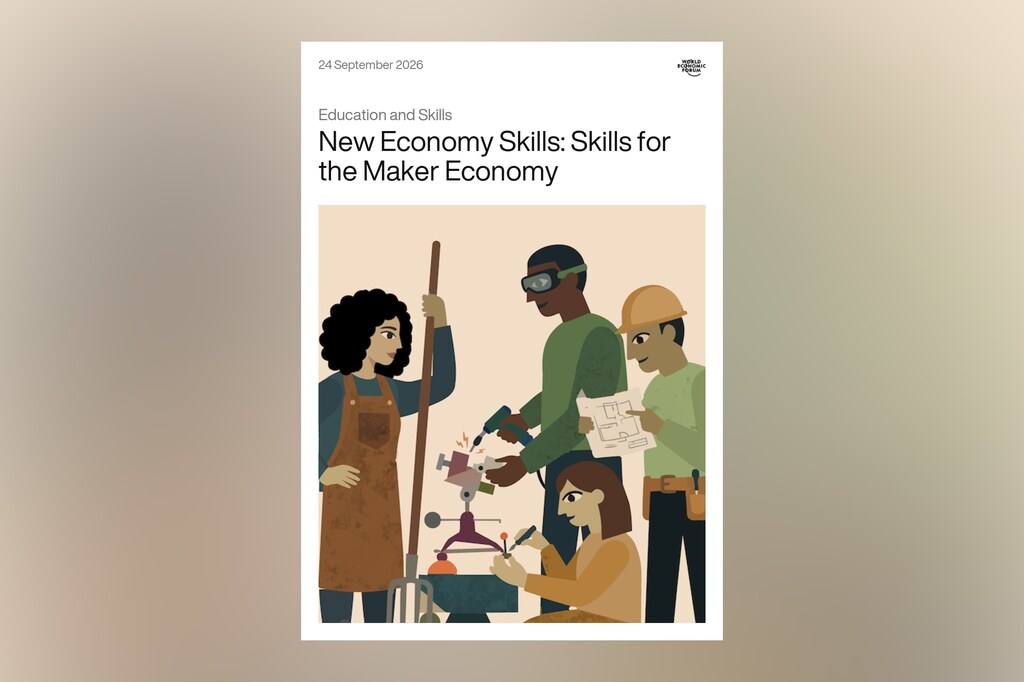
But one point that I think is probably consistently true for over the last 10 years, we have found business leaders telling us in one form or the other that for about 60 or 70 percent of them, the lack of skilled entry-level workers is one of the major things holding back the transformation of their organisations, which means that with or without artificial intelligence what the education and university systems have been producing in terms of talent, while it may do it that while there are many good things about it, it doesn't always equip young people with the new economy skills that they need today.
And so if that is the case, then a lot more effort needs to go into building simply those new economy's skills inside education systems. And as they enter the workforce.
And I think that's where we have to build the bridge. That's where a lot of the Forum's time and effort is going to be going, ensuring that those cross-cutting new economy skills are built up through education systems and as they enter the workforce, because that's going to necessary regardless of the particular shape of an org structure across any industry.
Gayle Markovitz: Do you feel like traditional four-year, three, four-year degrees are still relevant? And do you think education is keeping up?
Ravi Kumar: That's a great question. You know the current system of going to an academic, full-time academic intervention for the first 25 years of a life, working for the next 50 years and then retiring is a linear template from the industrial revolution, where the world was running at a much slower pace.
With the clock speed we have, I think we have to revisit that template where the K-12 schools should kind of focus on building lifelong learners. And then you have partnerships, industry partnerships for I would call it digital apprenticeships or AI apprenticeships or whatever you like. And then we draw learning resources all our life on a continual basis.
I mean, today the alumni associations of schools are actually for networks, not really to draw resources all your life. I would think that template should be revisited. You should intertwine work and learning resources all of your life because the change is happening in the middle. It's not happening on the front and at the back. It's happening in middle when you need it the most.
So there is a certain revisit. Every institution is doing some experiments, but it's not as mainstream. I wish we could you know, we could intertwine a few years of that undergrad education into apprenticeships in a different form. This is AI-led apprenticeships or digital apprenticeships. And then we draw learning resources all our life.
Saadia Zahidi: When we look at sort of K through 12 education, let's also not forget that that is the place where young people learn how to be members of society. There's so many other sort of skill sets and traits and characteristics that are built up during that time that are incredibly important.
But in many parts of the world, that K through twelve education system is designed for competition and for rank-ordering students by the end of a school year, which is very different from the skills that are going to be needed in the future. Very few of those systems actually teach some of those interpersonal dynamics that teach what is needed in terms of collaboration. So the earlier that can begin, I think the healthier it is for societies as a whole, much less for businesses and the economy.
And then on the university point, absolutely, and this is why we've set up at the Forum the First Mile Sandbox, which is all about creating those industry partnerships with universities, including in the digital apprenticeship space that Ravi was mentioning. And we're beginning with five industries, and we plan to roll that out across all the various industry groupings that the forum works with exactly for this reason, because just this entire methodology has to change.
And to Ravi's point, some of this is right now about that sort of first mile sandbox. And it's really focused on that early part of the career. But this needs to be continuous across the entire life cycle.
And there is an interesting stat where something like 0.11% of the GDP of OECD countries is spent on the lifelong learning piece, the post-university learning, retraining, and upscaling. Many large businesses that can afford it spend thousands and thousands per employee in terms of retraining and reskilling.
If that entire system, which does have enough funding in it, could just be better connected into institutions who job it is and who have really the expertise, universities and colleges and community colleges, that can really do this at scale, and if we could do that throughout entire life cycles, that would really pay off.
And that's going to be necessary. I think, you know, going back to the point that I was making earlier around policymakers, that is essentially how policymakers will have to rethink the incentives they create for collaboration between private sector and the education sector.
Gayle Markovitz: I have a teen. And I wonder, so asking for a friend, Ravi, if there was one piece of advice that you would give her if she were graduating this year, 2026, now as she's looking for a job, and then perhaps once she's started that job, what would the advice be?
Ravi Kumar: I have two toddlers at home. I wish I could tell them this. I would say the future is going to be much more interdisciplinary. You don't need to be a computer science graduate to thrive in the AI era. You need to figure out a way to apply the technology, this extraordinary technology. You know, it's a significant shift in terms of capability from the technologies of the past. How do you integrate that into everything you do at a workplace in your professional life?
O ne of the policymakers asked me this question saying, and what should K-12 schools and undergrad schools do? And you know with related to AI. I mean it's funny we tell students if you use AI at your work at your class we're going to fire you and we're telling employees if you don't use we'll fire you and you know the dichotomy of dealing with that is you should build native skills, a class without AI, and you should build, you should do your homework and your evaluations with AI.
What then happens is you power your native skills with an amplification with AI, so effectively you have the native skills to do the judgement, which Saadia was referring to outcomes, accountability, and intellectual curiosity and everything else, but you then amplify yourself with AI.
So I would actually believe build the native scales without it and use it to amplify it and you know try to power this with interdisciplinary opportunities.
You could, be a journalist you could be a biologist you be a chemist, you could be a lawyer. You just have to look at this technology and say, you know, it's available on your fingertips. How do I integrate it into everything I do and create more productivity, new products, new services?
Gayle Markovitz: How would the economies who are doing this right look different to those who get it wrong?
Saadia Zahidi: Let me maybe just give a quick overview of a scenarios piece that we did, and just in very simplistic terms, think of one vector where it's about how quickly technology is moving forward and being integrated across an economy, and think of the other vector as how quickly people are being skilled, re-skilled, up-skill. And essentially, the only no-regret move available to policymakers, is to combine that technology investment with the people-based investment.
There is essentially no such thing as getting the returns from the technology investment without the equivalent people investment, because these two things have to work together. There is no other way.
And so I'd say the first thing is, economies that understand that, that do not think that the people related investments are an afterthought. As Ravi said, they have to be integrated into that stack to begin with, that has to be number one, just that basic understanding.
I think the second piece is around raising the digital floor for everybody. Because I think a lot of organisations, businesses, governments are thinking about that sort of top end. But what we still have to remember is there's nearly 3 billion people across the planet that still don't have basic digital connectivity. And so this is just an extremely fast-growing chasm between the haves and the have-nots. And so the digital floor does have to be raised for everybody.
And then the third element is the public-private collaboration that is going to be needed to manage this well. And I don't want to boil it down to sort of, you know, just a basic term like that.
It's everything that we've just been talking about. It is that element of, yes, businesses have to do a lot within. Yes, governments have to think a lot about policymaking on their own. But those two sectors will have to talk much more to each other when it comes to managing this workforce transformation.
Robin Pomeroy: Saadia Zahidi, Managing Director of the World Economic Forum. You also heard Ravi Kumar, CEO of Cognizant. They were speaking to my colleague Gayle Markovitz.
The World Economic Forum and its partners do lots of research into the future of jobs and skills, and on artificial intelligence more widely. Find that on our website, links in the show notes.
And it’s one of the subjects we watch closely on Radio Davos - make sure you are following us wherever you get podcasts and you can find the Forum’s three weekly podcasts at wef.ch/podcasts.
Radio Davos will be back next week, but for now thanks to you for listening and goodbye.
Artificial intelligence is already having an impact on the way most of us work - but it’s still early days and it's hard to predict exactly which jobs will disappear completely, what new ones will be created, and when and where this will happen.
It’s a subject that's important to all of us - so Radio Davos spoke to the head of an AI services firm, Ravi Kumar of Cognizant, and to the head of the World Economic Forum’s Centre for the New Economy and Society, Saadia Zahidi. Both have unique insights into the impact of AI on the economy, on employment, and the implications for education and training.
世界の課題を読み解くインサイトと分析を、毎週配信。
Richard Florida, Vladislav Boutenko and Drishti Sharma
2026年8月17日