
Interest in retail investing is at an all-time high – but there are still barriers to participating.
Access, education, trust and investing catalysts are the four areas that need addressing.
Promoting equity in retail investing is a shared public-private responsibility.
Retail investing is here to stay. Despite fears of fall-back to pre-Covid levels after people resumed “back-to-normal” lifestyles, data shows how individual participation in capital markets has effectively been pushed to a whole new level, with further growth expected in the upcoming years.
While the World Economic Forum's findings from the 2024 Global Retail Investor Outlook confirmed the importance of the role played by retail investing in the reinforcement of long-term financial resilience, both at an individual and system level (e.g. lower reliance on already-lagging state pension coverage), ensuring successful participation requires a proactive public-private effort.
Building on the “Empowered Investor” concept initially introduced in the 2022 edition of the Forum’s Future of Capital Markets report, a four-pillar framework emerges as a potential guide to identify key levers through which continued and successful retail engagement in capital markets can be nurtured. Ensuring systematic investor empowerment is crucial to mitigate factors preventing participation, such as sub-optimal investing budgets, and under-performance issues like limited returns from investing.
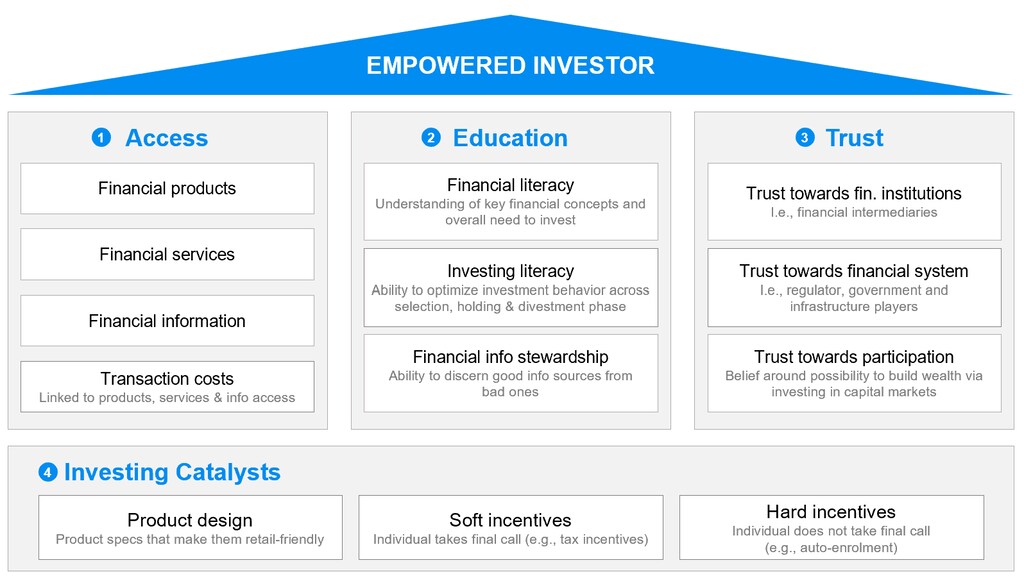
To enable successful retail participation in the long term, crucial gaps across access, education, trust and investing catalysts need to be jointly addressed by financial system stakeholders.
1. Democratize access to capital markets
While the advent of technology and low-cost brokerage platforms have effectively reduced market entry barriers over the years, retail investors across the world are still often de facto excluded from certain investing opportunities as well as from professional guidance services (an example of the “advice gap”). In times of market volatility and steep inflationary cycles, the need for predictability and available income control are shaping individuals’ participation choices, making access to the right products and services a crucial driver of successful participation.
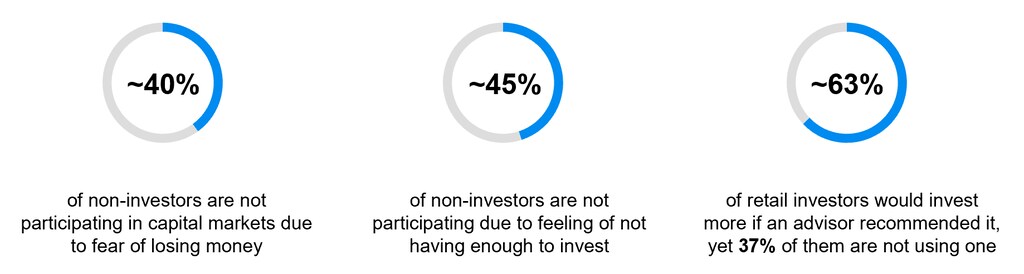
As individuals’ participation in capital markets keeps growing, financial institutions and policy-makers can play a decisive role in addressing access-related challenges. Key calls to action include:
Increasing participation confidence and “low-minimum” product awareness through ongoing investor support and educational campaigns.
Democratizing access to professional guidance services through AI-enabled operating and service models, with the goal of reducing the “advice gap”.
Mitigating high transaction costs currently faced by retail investors by promoting fair access to products, services and financial information.
2. Promote widespread financial education
Financial education is a key driver behind individuals’ participation in capital markets, with broad literacy gaps persisting despite all-time high interest in investing. Even when poor financial education does not directly prevent participation, systematic behavioural biases across product selection, investment holding and divestment phases can lead to poor returns, undermining long-term wealth creation potential.
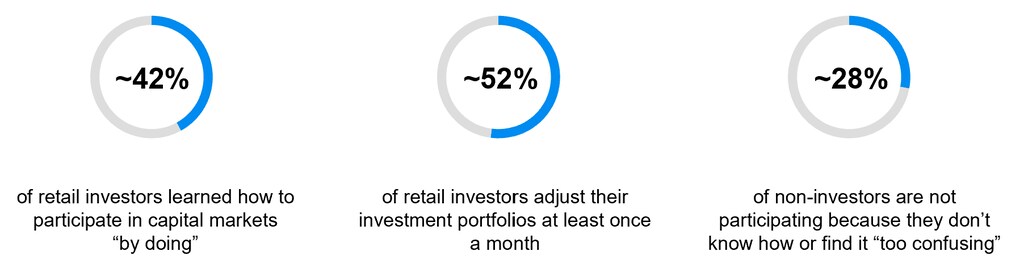
Public-private action can play a decisive role in addressing persisting retail investors’ education gaps. Key calls to action include:
Advocating for the systematic introduction of financial literacy promotion initiatives at school, as well as in the workplace via employee benefits packages.
Promoting regulatory frameworks that enable flexible delivery of contextual, data-enabled personalized guidance to individuals throughout the full investing life cycle (beyond disclosure duties ahead of financial product/service purchase).
Increasing retail investor awareness around “beginner-friendly” products, while educating them about their benefits, e.g. via third party-maintained labelling frameworks.

3. Build and nurture retail investors' trust
Trust levels towards the financial system greatly differ across countries and generations, peaking for developing economies and younger investors. While greater retail investor trust is directly linked to an increase in participation, in a world where free information proliferates and intermediaries’ conflicts of interest persist, excessive trust can also end up harming investing outcomes.
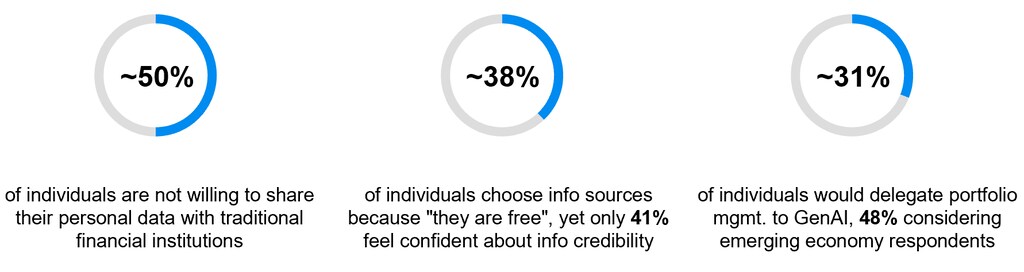
In order to solidify trust in the financial system while ensuring alignment of interests between its key actors and retail investors, a number of initiatives can be undertaken by both policy-makers and financial institutions. Key calls to action include:
Facilitating consumption of vetted financial content across most popular info channels, while increasing transparency around fee structures and portfolio-level reporting.
Ensuring retail investor interest “by design” through fairer operating and business models adoption (e.g. fee-only advice).
Promoting a “healthy scepticism” mindset among retail investors to enable self-stewardship of own interests (e.g. when making value-for-money considerations).
4. Incentivize participation and optimal behaviours
While the diversity of the retail investor base demands personalized value propositions, several purpose-built products and soft/hard incentivization structures have proved to be successful engagement catalyzers. From tax breaks to auto-enrolment pension programmes, all the way to frequent contribution plans, product design can play a key role when it comes to prompting capital market participation, while also eliciting desirable investing behaviours.
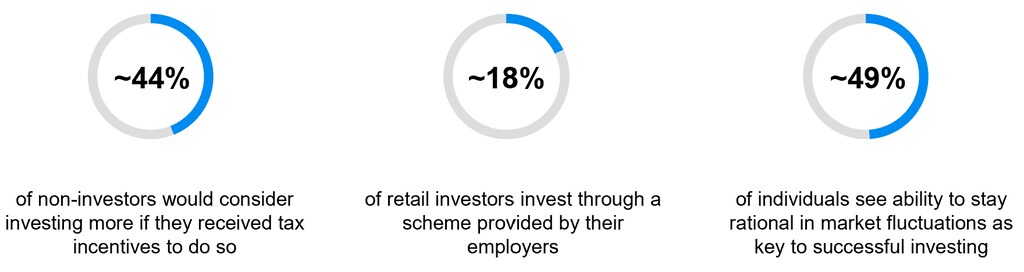
By acknowledging retail investors’ unique behavioural patterns and preferences, asset managers, wealth managers and public entities within the financial system are in a privileged position to catalyze participation via bespoke product designs. Key calls to action include:
Promoting distribution of tax-advantaged investing plans with the aim of curbing individual participation inertia, and scepticism or lack of clarity towards financial products.
Mitigating retail investors’ fear of loss and hyper-reactivity to market shifts through tailored design features, e.g. capital protection clauses, frequent contribution schemes.
Leveraging the natural fiduciary relationship between employers and employees on financial matters to promote long-term wealth accumulation plans.
While the retail investing movement is already making great strides, its full potential is yet to be seen. Promoting fair market participation outcomes is a shared public-private responsibility, with investor empowerment becoming the cornerstone of an increasingly diverse financial ecosystem.