If you were asked to name a few global cities which ones would spring to mind? New York, perhaps? London? Tokyo? You may need to think outside the box, however, and update your notion of what a global city really is – a new report also classifies Birmingham, Bratislava and Busan-Ulsan as global cities.
According to a Brookings Institute and JPMorgan Chase study, our idea of a global city has become outdated in a rapidly urbanizing world in the midst of seismic technological change. A handful of financial centers, like New York, London and Tokyo, no longer drive world economy. Instead a “vast and complex” network of cities – some surprisingly small, others mid-sized – powers the international flow of goods, services, people, capital and ideas.
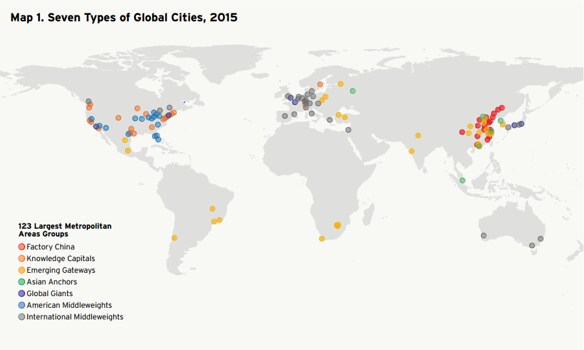
The report divides these urban metro areas into seven types of global cities, from “Global Giants” such as New York, London and Tokyo to “International Middleweights” such as Birmingham, Melbourne and Tel Aviv.
Why these cities matter
Amid the current prolonged period of sluggish economic growth, it’s important for business leaders and policy makers to recognize these cities’ contributions to growth and opportunity. This also means understanding how well prepared they are for the future.
Nearly all of the world’s 123 largest conurbations generate over $100 billion per year each. Added together, this amounts to a third of global economic output created by just one-eighth of the world’s population.
The report’s analysts mapped these cities against dozens of standardized metrics – indicators such as patents per capita, aviation passengers, even internet download speeds – to try to understand what really makes a global city.
Armed with this information, the researchers then clustered the cities based on size, structure and competitiveness. Interestingly, using these measures, many of the conurbations have more in common with other cities across the world than with those in their own backyard.
Here’s a more detailed look at the seven types of global cities:
Global Giants: (Six corporate/financial hubs)
London, UK; Los Angeles, USA; New York, USA; Osaka-Kobe, Japan; Paris, France; and Tokyo, Japan.
Asian Anchors (Five pacific-oriented powerhouses)
Beijing, China; Hong Kong, SAR, China; Moscow, Russia; Seoul-Incheon, South Korea; Shanghai, China; and Singapore.
Emerging Gateways (28 business and transportation entry points for emerging markets)
Ankara, Turkey; Brasilia, Brazil; Busan-Ulsan, South Korea; Cape Town, South Korea; Chongqing, China; Delhi, India; East Rand, South Korea; Guangzhou, China; Hangzhou, China; Istanbul, Turkey; Jinan, China; Johannesburg, South Africa; Katowice-Ostrava, Poland/Czech Republic; Mexico City, Mexico; Monterrey, Mexico; Mumbai, India; Nanjing, China; Ningbo, China; Pretoria, South Africa; Rio de Janeiro, Brazil; Saint Petersburg, Russia; Santiago, Chile; Sao Paulo, Brazil; Shenzhen, China; Tianjin, China; Warsaw, Poland; Wuhan, China; and Xi'an, China.
Factory China (22 second- and third-tier Chinese cities)
Changchun, Changsha, Changzhou, Chengdu, Dalian, Dongguan, Foshan, Fuzhou, Haerbin, Hefei, Nantong, Qingdao, Shenyang, Shijiazhuang, Suzhou, Tangshan, Wenzhou, Wuxi, Xuzhou, Yantai, Zhengzhou, and Zibo.
Knowledge Capitals (19 productive, mid-sized innovation centers)
Atlanta, USA; Austin, USA; Baltimore, USA; Boston, USA; Chicago, USA; Dallas, USA; Denver, USA; Hartford, USA; Houston, USA; Minneapolis, USA; Philadelphia, USA; Portland, USA; San Diego, USA; San Francisco, USA; San Jose, USA; Seattle, USA; Stockholm, Sweden; Washington DC, USA; and Zurich, Switzerland.
American Middleweights (16 mid-sized U.S. metro areas)
Charlotte, Cincinnati, Cleveland, Columbus, Detroit, Indianapolis, Kansas City, Miami, Orlando, Phoenix, Pittsburgh, Riverside, Sacramento, San Antonio, St. Louis, and Tampa.
International Middleweights (26 mid-sized cities across globe)
Brussels, Belgium; Copenhagen-Malmö, Denmark/Sweden; Frankfurt, Germany; Hamburg, Germany; Karlsruhe, Germany; Köln-Düsseldorf, Germany; Milan, Italy; Munich, Germany; Nagoya, Japan; Rome, Italy; Rotterdam-Amsterdam, Netherlands; Stuttgart, Germany; Vienna, Austria; Bratislava, Slovakia; Athens, Greece; Barcelona, Spain; Berlin, Germany; Birmingham, UK; Kitakyushu-Fukuoka, Japan; Madrid, Spain; Melbourne, Australia; Montreal, Canada; Perth, Australia; Sydney, Australia; Tel Aviv, Israel; Toronto, Canada; and Vancouver, Canada.