
China’s new consumer class is on the rise. With a larger working population than the US and Europe combined, China has a growing bastion of consumers who will have a powerful effect on the global economy.
A new report by Goldman Sachs looks at the current and future patterns of the Chinese consumers, and how they compare to the US.
Who are China’s consumers?
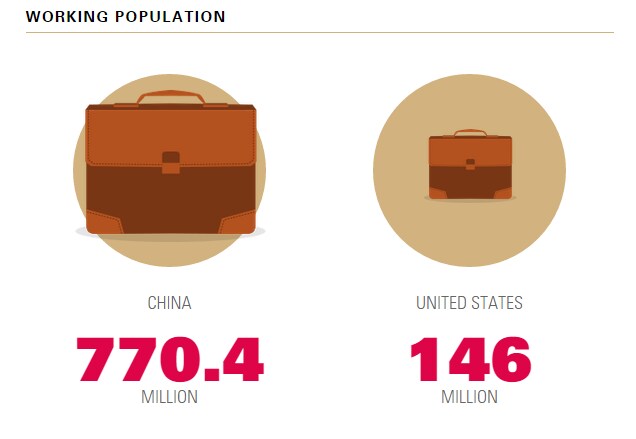
Source: 2013 figures from China NBS, CNPolitics, Goldman Sachs Global Investment Research, US Bureau of Labor Statistics, US Department of Defense
Despite Asia’s rising incomes, China’s middle class is still relatively small, making up around 11% of the entire population. Less than 2% of the working population can pay income tax.
The report by Goldman Sachs divides the Chinese consumers into four groups, depending on purchasing power:
1. The wealthiest citizens who will influence trends the most ($500,000 annual income per capita)
2. The middle class who are on the public payroll ($11,733 annual income per capita)
3. Workers who have moved to cities for better-paying jobs ($5,858 annual income per capita)
4. Rural workers ($2,000 annual income per capita)
What do they want?
The average daily spending in the US is $97; it’s $7 in China. Currently, half of all spending in China is on food and clothing. These consumption patterns are likely to change, as disposable incomes rise.
There are seven desires which can explain Chinese consumer spending:
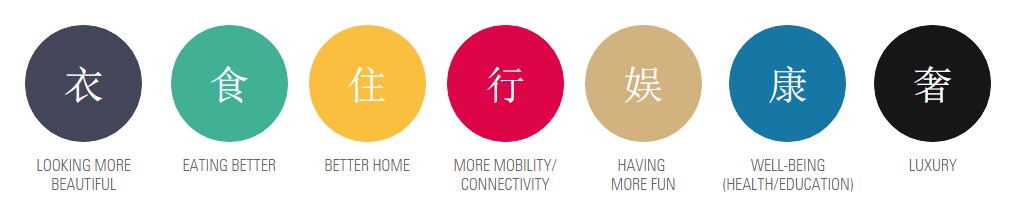
Source: Goldman Sachs
What does the future look like?
Comparing consumption patterns in China with those of the US gives a good indication of what can be expected in the future, as incomes rise. The category with the potential of seeing the biggest growth is “fun”. In the US, consumers currently spend 17.3% of personal spending on fun, compared to 9.2% in China. The majority of the Chinese consumer’s spend their income on clothes, food and “looking more beautiful”, according to Goldman Sachs.
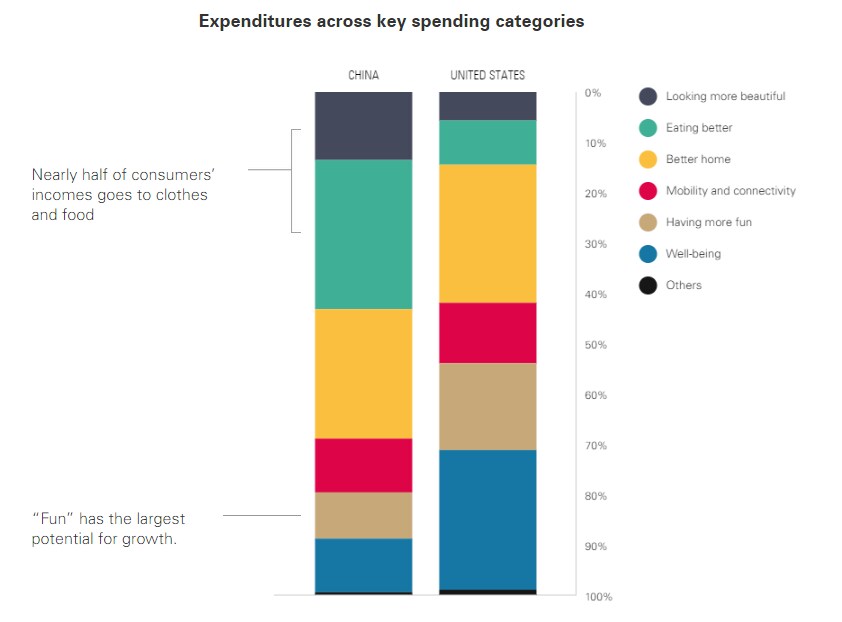
Source: Euromonitor, CEIC, Goldman Sachs Global Investment Research
With more investment in “fun” activities, combined with cheaper electronics such as low smartphone prices, the Chinese media and technology industry will also see some big opportunities for growth.
Watch: How is China shaping the future of media and entertainment?
And as China will have a population of 223 million people aged 65 and over in 2030, compared to 75 million in the US, Chinese consumers will be looking more to their future and investing in health and education.
E-commerce will be another expanding market for Chinese consumers, indicated by a rapid growth in shipping: in 2014, 10 billion packages were delivered, compared to 1 billion in 2006.
Watch: Alibaba’s founder Jack Ma on the future of e-commerce, Annual Meeting 2015
Have you read?
6 charts that explain China in the global economy
Who would benefit from a US rates hike?
Will the US or China be tomorrow’s economic superpower?
Source: Goldman Sachs, China is transforming the global economy
Author: Jenny Soffel is Website Editor at the World Economic Forum
Image: China, concerned about consumer inflation and risks of social unrest, announced a slew of measures to cool the red-hot property market in mid-April. REUTERS/David Gray